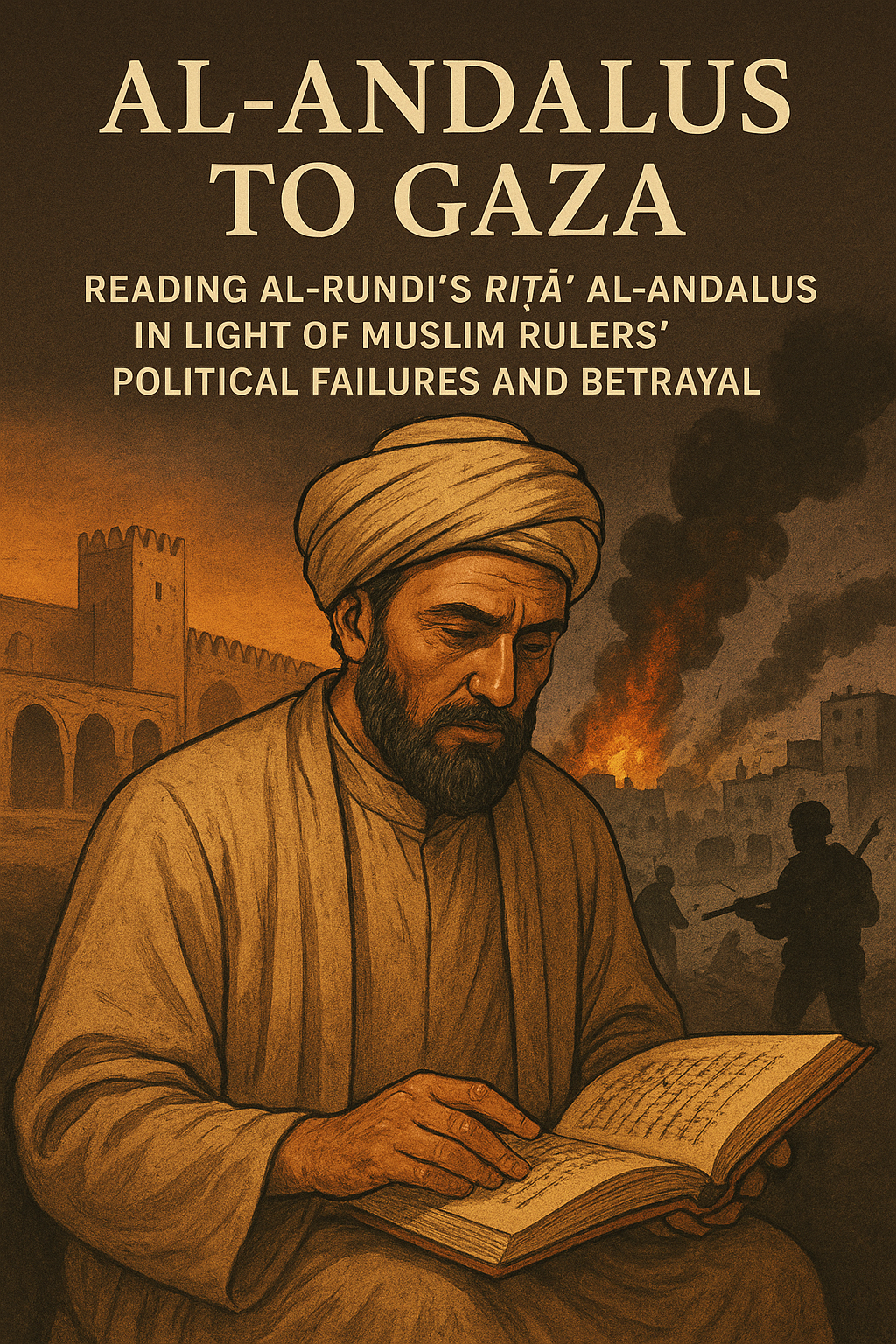
Al-Andalus to Gaza: Reading Al-Rundī’s Riṯāʾ al-Andalus in Light of Muslim Rulers’ Political Failures and Betrayal
By Abdul Hai
There are three notable events in Islamic history that shook the Muslim Ummah to its core. The first was the series of Christian Crusades between 1096–1291, which appeared to break the very spirit of the Muslims. The second was the Mongol assault on Baghdad in 1258, during which hundreds of thousands of Muslims were massacred. The destruction of Baghdad was so immense that even great men hesitated to record it. The eminent historian Ibn al-Athīr (1160–1233), in his masterpiece al-Kāmil fī al-Tārīkh, wrote:
“For many years, I abstained from recounting this event… I earnestly wish I had never been born, and I wish I had passed away before this, fading into obscurity.”
The third was the expulsion and persecution of Muslims from Spain between 1492 and 1614 an episode often forgotten. Al-Andalus, once a flourishing centre of Islamic civilisation, was transformed into a place of exile, oppression, and erasure.
Today, history appears to be witnessing a fourth such calamity: the massacre and genocide in Gaza. Yet, a profound link connects these events namely, the determination and resistance of Muslims to foreign occupation. Just as Islam and the Muslim community ultimately endured the Crusades, survived the Mongol invasion of Baghdad, and withstood the Spanish Inquisition, there is little doubt that, by the will of Allah (may He be exalt), the struggle of Gaza will also be recorded as part of history. The people of Gaza and Palestine will remain in their land, under their banner, and under the flag of Islam. At the same time, history will not forget those who have facilitated such atrocities. Responsibility lies not only with foreign powers and European colonisers, but also, tragically, with Muslim rulers of the Arab states who have been complicit in this injustice. They, too, will be remembered though not in honourable terms, but as traitors to the Muslim nation and the Ummah.
In this sense, al-Rundī’s Lament serves as a powerful lens through which to view and understand our present reality. For history repeats itself, history teaches its lessons, and history preserves the memory of betrayal. Those who aided in the oppression of Muslims will be remembered with disgrace in this world, and, according to the words of the Prophet Muhammad (peace be upon him), will face accountability in the Hereafter.
Al-Rundī’s Lament and the Silence of Rulers
In the centuries following the fall of al-Andalus, Muslim poets turned their grief into verse. Among them, Abū al-Baqāʾ Ṣāliḥ ibn Abī Sharīf al-Rundī (1204–1285) of Seville stands out. His elegy Riṯāʾ al-Andalus captured not only the devastation wrought by Christian forces but also the deeper wound of Muslim betrayal. Neighboring rulers, living in safety and comfort, watched the suffering of their brothers without lifting a hand. Al-Rundī’s verses, though centuries old, speak to our own time. The greatest anguish does not arise solely from the violence of enemies but from the moral paralysis of Muslim leaders who betray both their faith and their people. Just as the poet exposed this failure in the thirteenth century, his words expose today’s silence in the face of Gaza.
The Divine Law of Rise and Fall
Central to Al-Rundī’s poem is the reminder that everything in creation is subject to decline once it reaches its peak. He begins with the famous line:
“لِكُلِّ شَيْءٍ إِذَا مَا تَمَّ نُقْصَانٌ”
“Everything, once it reaches its perfection, is destined to diminish.”
This reflects the divine sunnah that governs human history. The Qur’ān declares:
وَلَا تَدْعُ مَعَ ٱللَّهِ إِلَـٰهًا ءَاخَرَ ۘ لَآ إِلَـٰهَ إِلَّا هُوَ ۚ كُلُّ شَىْءٍ هَالِكٌ إِلَّا وَجْهَهُۥ ۚ لَهُ ٱلْحُكْمُ وَإِلَيْهِ تُرْجَعُونَ
“Do not invoke any other god alongside Allah. There is no god except Him. Everything is bound to perish except He Himself. All authority belongs to Him, and to Him you will ˹all˺ be returned.” (Qur’an 28:88)
Yet people often forget this truth. They assume their lives, possessions, and empires will endure forever. Al-Rundī warns that perfection is followed inevitably by decay, and wealth or power is only temporary before all must return to their Lord.
Wealth, Luxury, and Neglect of Duty
This message resonates with the condition of contemporary Muslim rulers. Today, the Gulf states Saudi Arabia, the United Arab Emirates, Bahrain, Qatar, and others rank among the richest nations in the world. They have built dazzling empires of luxury and influence. Yet they have chosen indulgence over responsibility, constructing palaces of wealth while Gaza burns.
Al-Rundī’s words echo across centuries:
“فَالْيَغْتَرَّ بِطِيبِ الْعَيْشِ إِنْسَانٌ”
“Let no one be deceived by the sweetness of life.”
History is clear: no ruler, no empire, no treasure has endured. By neglecting Gaza through silence, refusal to intervene, or complicity with Western powers today’s rulers repeat the errors of al-Andalus. Their palaces will not shield them from decline, and their betrayal will be remembered long after their wealth has vanished.
Warnings from History
Al-Rundī reminded his audience of vanished kings and fallen empires:
أَيْنَ الْمُلُوكُ ذَوُو التِّيجَانِ مِنْ يَمَنٍ
وَأَيْنَ مِنْهُمْ أَكَالِيلٌ وَتِيجَانُ؟
وَأَيْنَ مَا شَادَهُ شَدَّادٌ فِي إِرَمٍ
وَأَيْنَ مَا سَاسَهُ فِي الْفُرْسِ سَاسَانُ؟
وَأَيْنَ مَا حَازَهُ قَارُونُ مِنْ ذَهَبٍ
وَأَيْنَ عَادٌ وَشَدَّادٌ وَقَحْطَانُ؟
“Where are the crowned kings of Yemen, and their jewel-studded crowns? Where are the structures of Iram, or the empire of the Sassanians? Where is the gold of Qarun, and the tribes of ʿĀd, Shaddād, and Qahtān?”
His questions are not rhetorical flourishes; they are lessons. Worldly grandeur, once thought invincible, was reduced to ruins. The same fate awaits rulers of today who mistake temporary power for permanence. Contemporary scholars echo this warning. Christopher Davidson, in his book After the Sheikhs: The Coming Collapse of the Gulf Monarchies, highlights the mounting internal and external pressures eroding Gulf rulers’ authority. Obsessed with Western lifestyles and desperate to maintain power, these regimes suppress religious identity and cling to fragile alliances. But history teaches that such strategies cannot withstand the judgement of their people or of God.
Communication Then and Now
In his poem, Al-Rundī asked:
“أَعِندَكُمْ نَبَأٌ مِنْ أَهْلِ أَنْدَلُسٍ”
“Do you have any news from the people of al-Andalus?”
He lamented the slow spread of news by sea, horse, and caravan. Today, by contrast, the genocide in Gaza unfolds before the world in real time. Images of burned children, shattered homes, and mass graves reach us instantly. Ignorance can no longer be claimed.
If the rulers of Al-Rundī’s time could be excused for their distance, the rulers of today cannot. They see the atrocities daily, yet remain passive. Their condemnations, issued in hollow statements, are as empty as Jarīr’s satirical line mocking Al-Farazdaq’s empty threats:
زَعَمَ الفَرَزْدَقُ أَنَّهُ سَيَقْتُلُ مُرَبَّعًا، أَبْشِرْ بِطُولِ سَلَامَتِكَ يَا مُرَبَّعُ
“Al-Farazdaq claimed he would kill Murabbaʿ. May you live long, O Murabbaʿ!”
The Illusion of Western Protection
Modern rulers not only neglect Gaza but tie their survival to Western powers. This is a profound illusion. The West has never acted out of concern for them, only out of interest. When rulers are no longer useful, they are discarded. Donald Trump made this plain when he declared that Saudi Arabia’s monarchy would not last even week without U.S. protection. Qatar, despite showering millions to buy influence, still suffered humiliation at Western hands. Their deference reveals weakness: unlike the rulers of Al-Andalus, who at least once governed independently, today’s leaders are enslaved within their own lands, beholden to foreign patrons.
Faith and Moral Paralysis
Al-Rundī’s question lingers:
“إِن كانَ في القَلبِ إِسلامٌ وَإِيمانُ”
“If in the heart there still remains Islam and faith.”
Past rulers, though often tyrannical, at times, rose to defend Muslim honor. Even Hajjaj ibn Yusuf infamous for his cruelty dispatched an army to Sind after hearing the plea of a single woman. By contrast, modern rulers witness the wholesale slaughter of women and children in Gaza yet remain unmoved. Their hearts appear emptied of faith, their loyalties bound to worldly masters.
Gaza as the Mirror of Betrayal
The horrors of Gaza leave no excuse. Families are torn apart, children killed before their parents’ eyes, bombs raining down from Western planes. In this, Muslim rulers’ betrayal is laid bare. Their silence questions the very fabric of Islamic brotherhood. Sheikh Abdul Aziz al-Tarifi once ruled that if a Muslim seeks the aid of non-Muslims against another Muslim individually, it is a sin. But if a Muslim state assists non-Muslim powers against fellow Muslims, it constitutes disbelief. By this standard, the Gulf regimes’ complicity with Israel marks them as more than failures it marks them as traitors to their faith.
Conclusion
From al-Andalus to Gaza, history repeats. Wealth, power, and kingdoms rise only to fall. Rulers who betray their obligations fade into obscurity, remembered only as warnings. Al-Rundī’s elegy is not a relic of the past but a mirror for the present: a reminder that divine justice endures, while tyranny, betrayal, and arrogance are fleeting. The rulers of today, who cling to luxury and seek protection abroad while Gaza bleeds, are already in decline. Their names, like those of past kings who abandoned justice, will endure only as cautionary tales etched into history. It is human nature to feel sorrow, to experience moments of despair and disbelief when confronted with events that surpass imagination. To awaken each morning uncertain of what the day will bring, to see families go to bed unsure who will rise again, to witness fathers clutching fragments of their children’s bodies because other parts have been obliterated, and to observe mothers marking their children’s names on the limbs of the dead, these realities produce profound grief. For the people of Gaza, and for devout Muslims everywhere, such scenes engender helplessness, despondency, and more questions than answers.
Yet the Muslim conception of victory is not defined by the immediate outcomes of battle but by what Allah (exalted be He) and His Messenger (peace and blessings be upon him) have decreed. History records that Muslims have repeatedly returned to reclaim what was taken from them. We are a ummah of resilience, who confront their adversaries with faith, resolve, and courageous devotion to Allah and His Messenger. Although the present conflict in Gaza appears dire, with many lives lost and much devastation endured, these trials may be understood, in Islamic consciousness, as signs that vindication will come. God’s word will be exalted in Gaza and Palestine, and the people of Palestine will ultimately emerge victorious. Those who carry the banners of Islam will be remembered in accounts of triumph, and Muslims will recount stories of endurance and deliverance. Those who betray the Ummah of the Prophet Muhammad (peace be upon him), much like traitors of earlier ages, will be remembered as such and will face the consequences of their treachery in this world; their reputations will be condemned, and their deeds scorned. What lies in the hereafter, however, transcends present suffering for such leaders. The poem above should not be read as an expression of despair but as a meditation on Gaza as a nascent site of eventual vindication. Were al-Rundī present among us today, his lines might resound not in lamentation alone but in the affirmation of victory for the people of Palestine and Gaza. This is the perspective we must remember.
Appendix: مرثية الأندلس – أبو البقاء الرندي
| English Translation | النص العربي |
| For everything, once perfected, decline begins. | لكل شيءٍ إذا ما تم نقصانُ |
| Let no man be deceived by the sweetness of life. | فلا يُغرُّ بطيب العيش إنسانُ |
| The days are but changing dominions, as you have seen. | هي الأيامُ كما شاهدتها دُولٌ |
| He whom one age delighted, other ages grieved. | مَن سَرَّهُ زَمنٌ ساءَتهُ أزمانُ |
| This world spares no one forever. | وهذه الدار لا تُبقي على أحد |
| Its fortune never rests on one condition. | ولا يدوم على حالٍ لها شان |
| Time must tear apart every coat of mail, | يُمزق الدهر حتمًا كل سابغةٍ |
| When sharp swords and spears spring forth. | إذا نبت مشْرفيّاتٌ وخُرصانُ |
| Every sword is drawn for ruin, even if, | وينتضي كلّ سيف للفناء ولوْ |
| It belonged to noble kings and rested in Ghumdan. | كان ابنَ ذي يزَن والغمدَ غُمدان |
| Where are the crowned kings of Yemen? | أين الملوك ذَوو التيجان من يمنٍ |
| Where are their crowns and diadems? | وأين منهم أكاليلٌ وتيجانُ؟ |
| Where is what Shaddād built in Iram? | وأين ما شاده شدَّادُ في إرمٍ |
| Where is what Sāsān ruled in Persia? | وأين ما ساسه في الفرس ساسانُ؟ |
| Where is the gold that Qārūn possessed? | وأين ما حازه قارون من ذهب |
| Where are ʿĀd, Shaddād, and Qaḥṭān? | وأين عادٌ وشدادٌ وقحطانُ؟ |
| A decree befell them all, none could resist, | أتى على الكُل أمر لا مَرد له |
| Till they perished, as if they had never been. | حتى قَضَوا فكأن القوم ما كانوا |
| What was of kingdom and king, | وصار ما كان من مُلك ومن مَلِك |
| Is but like the tale of a dream. | كما حكى عن خيال الطّيفِ وسْنانُ |
| Time turned upon Dārā and his slayer. | دارَ الزّمانُ على (دارا) وقاتِلِه |
| Kisrā found no refuge even in his palace. | وأمَّ كسرى فما آواه إيوانُ |
| As if no cause ever eased hardship for him, | كأنما الصَّعب لم يسْهُل له سببُ |
| Nor did Solomon forever reign over the world. | يومًا ولا مَلكَ الدُنيا سُليمانُ |
| Calamities of time are many and varied. | فجائعُ الدهر أنواعٌ مُنوَّعة |
| Time brings both joys and sorrows. | وللزمان مسرّاتٌ وأحزانُ |
| Disasters have consolations to soften them, | وللحوادث سُلوان يسهلها |
| But none can console what befell Islam. | وما لما حلّ بالإسلام سُلوانُ |
| The Peninsula suffered a blow beyond solace. | دهى الجزيرة أمرٌ لا عزاءَ له |
| Uhud shook for it, and Thahlan crumbled. | هوى له أُحدٌ وانهدْ ثهلانُ |
| An evil eye struck Islam, and it was tried. | أصابها العينُ في الإسلام فامتحنتْ |
| Till many lands and regions were emptied of it. | حتى خَلت منه أقطارٌ وبُلدانُ |
| Ask Valencia what befell Murcia. | فاسأل (بلنسيةً) ما شأنُ (مُرسيةً) |
| Where is Xàtiva, and where is Jaén? | وأينَ (شاطبةٌ) أمْ أينَ (جَيَّانُ) |
| And where is Cordoba, abode of knowledge, | وأين (قُرطبة)ٌ دارُ العلوم فكم |
| Where so many scholars once had great rank? | من عالمٍ قد سما فيها له شانُ |
| Where is Ḥimṣ with its gardens so fair, | وأين (حْمص)ُ وما تحويه من نزهٍ |
| Its sweet river abundant and flowing? | ونهرهُا العَذبُ فياضٌ وملآنُ |
| They were the pillars of the land— | قواعدٌ كنَّ أركانَ البلاد فما |
| How can it stand if its pillars are gone? | عسى البقاءُ إذا لم تبقَ أركانُ |
| The pure faith weeps in sorrow, | تبكي الحنيفيةَ البيضاءُ من أسفٍ |
| As the lover weeps at parting. | كما بكى لفراق الإلفِ هيمانُ |
| Over lands emptied of Islam, | على ديار من الإسلام خالية |
| Desolate, now thriving with disbelief. | قد أقفرت ولها بالكفر عُمرانُ |
| Where mosques became churches, | حيث المساجد قد صارت كنائسَ ما |
| Filled with nothing but bells and crosses. | فيهنَّ إلا نواقيسٌ وصُلبانُ |
| Even the prayer-niches weep though stone, | حتى المحاريبُ تبكي وهي جامدةٌ |
| Even the pulpits mourn though made of wood. | حتى المنابرُ ترثي وهي عيدانُ |
| O heedless one—time holds a lesson for you. | يا غافلاً وله في الدهرِ موعظةٌ |
| If you are asleep, time is ever awake. | إن كنت في سِنَةٍ فالدهرُ يقظانُ |
| You walk proudly, distracted by your land— | وماشيًا مرحًا يلهيه موطنهُ |
| After Ḥimṣ, what homeland can deceive a man? | أبعد حمصٍ تَغرُّ المرءَ أوطانُ؟ |
| That calamity made us forget what came before, | تلك المصيبةُ أنستْ ما تقدمها |
| And with all time, it shall never be forgotten. | وما لها مع طولَ الدهرِ نسيانُ |
| O riders of noble, lean horses, | يا راكبين عتاق الخيلِ ضامرةً |
| Swift as falcons in the racecourse. | كأنها في مجال السبقِ عقبانُ |
| O bearers of keen Indian swords, | وحاملين سيُوفَ الهندِ مرهفةُ |
| That blaze like fire in the dark of battle. | كأنها في ظلام النقع نيرانُ |
| While you dwell in ease beyond the sea, | وراتعين وراء البحر في دعةٍ |
| With honor and dominion in your lands. | لهم بأوطانهم عزٌّ وسلطانُ |
| Have you news from the people of al-Andalus? | أعندكم نبأ من أهل أندلسٍ |
| Their tale has spread with the riders. | فقد سرى بحديثِ القومِ رُكبانُ؟ |
| How many oppressed cry out to us— | كم يستغيث بنا المستضعفون وهم |
| Slain and captive, yet no man is moved. | قتلى وأسرى فما يهتز إنسان؟ |
| Why this estrangement among Muslims— | ماذا التقاُطع في الإسلام بينكمُ |
| Are you not servants of God, brothers? | وأنتمْ يا عبادَ الله إخوانُ؟ |
| Are there no noble souls of lofty aims? | ألا نفوسٌ أبياتٌ لها هممٌ |
| No helpers, no allies for good? | أما على الخيرِ أنصارٌ وأعوانُ |
| O you, whose people were strong then humiliated— | يا من لذلةِ قومٍ بعدَ عزِّهمُ |
| Their state overturned by tyranny and oppression. | أحال حالهمْ جورُ وطُغيانُ |
| Yesterday they were kings in their dwellings, | بالأمس كانوا ملوكًا في منازلهم |
| Today, in the land of unbelief, they are slaves. | واليومَ هم في بلاد الكفرِّ عُبدانُ |
| If you could see them—bewildered, without guide, | فلو تراهم حيارى لا دليل لهمْ |
| Clothed only in garments of disgrace. | عليهمُ من ثيابِ الذلِ ألوانُ |
| If you saw their tears when they are sold, | ولو رأيتَ بكاهُم عندَ بيعهمُ |
| The sight would shake you, sorrow would seize you. | لهالكَ الأمرُ واستهوتكَ أحزانُ |
| O Lord, a mother and child torn apart, | يا ربَّ أمّ وطفلٍ حيلَ بينهما |
| As souls and bodies are wrenched from each other. | كما تفرقَ أرواحٌ وأبدانُ |
| And a girl, radiant as the sun at dawn, | وطفلةً مثل حسنِ الشمسِ إذ طلعت |
| As if ruby and coral were her form. | كأنما هي ياقوتٌ ومرجانُ |
| Dragged by the foreigner to shame unwillingly, | يقودُها العلجُ للمكروه مكرهةً |
| Her eyes in tears, her heart bewildered. | والعينُ باكيةُ والقلبُ حيرانُ |
| For such a sight, the heart melts in grief— | لمثل هذا يذوب القلبُ من كمدٍ |
| If within that heart lives Islam and faith. | إن كان في القلبِ إسلامٌ وإيمانُ |