Katerina Brac by Christopher J. Reid
Reviewed By
Abdul Hai
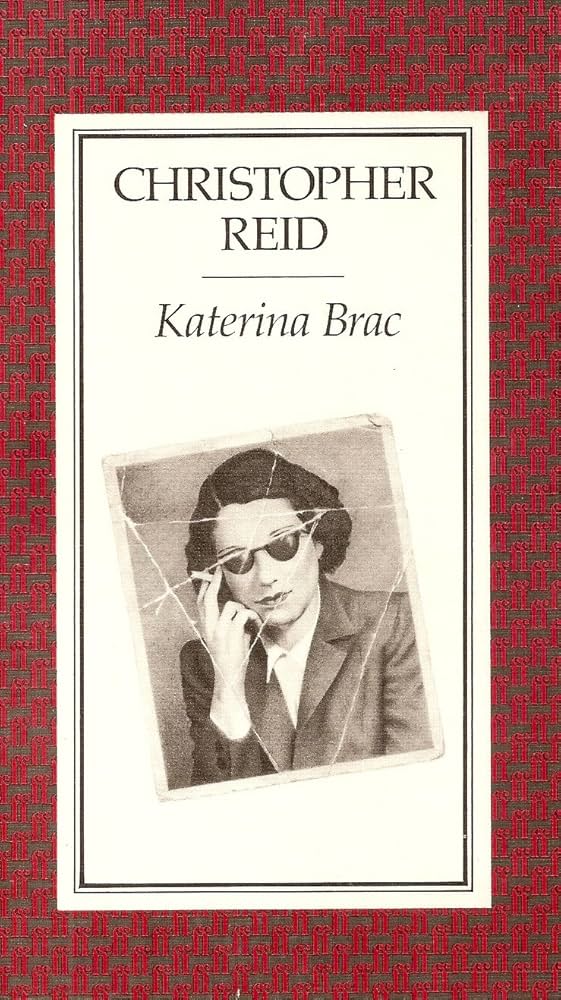
Katerina Brac is a collection of short poems by Christopher John Reid, a British poet, essayist, cartoonist, and writer. Katerina Brac, as indicated in the title, is a fictional and imaginary character originating from an unspecified foreign country. Reid presents the poems as if they were written in Brac’s own language, and subsequently translated into English. By adopting the conceit that the poems have been translated from Brac’s native tongue, Reid generates the impression that the work arises from a culture distinct from his own, possessing a worldview different from that of the author. The collection thus evokes a sense of the reader being an outsider, separated from Brac’s experiences, emotions, and perspective. This deliberate estrangement allows the reader to engage more intensely with the poems, fostering a deeper engagement with the text precisely because it is culturally and linguistically foreign.
For instance, in the poem Epithalamium, Reid writes:
Something as homely
as a cat or a clock.
But what you leave unsaid
sustains you
like the net of the heavens.
Man and wife
with your life between you
like a chessboard:
a palimpsest
of innumerable possibilities.
In these lines, the comparison of the “unsaid” to the “net of the heavens” is strikingly unusual, and the metaphor of a “palimpsest” conveys the notion of innumerable possibilities, a conceptual depth rarely encountered in everyday speech. What is perhaps most remarkable and simultaneously most challenging about this poem is the way it presents itself as a translation. In deliberately eschewing standard English conventions, the poem creates a subtle difficulty for the reader, encouraging a more inquisitive and reflective engagement in order to uncover its meaning. The collection explores a number of primary themes, including memory, nature, art, human relationships, time, and reflection. For example, in the poem Tin Lily, Reid evokes a vision of nature:
“…I mean not the seasons
of nature, but those speedier
human phases that run athwart them.”
Although the thematic concerns of the collection are present throughout, they are not always immediately obvious; the reader is often required to read carefully and interpret between the lines. This approach introduces an initial barrier to appreciation, which may, at times, discourage readers due to the complexity of the language and structure.
The collection is predominantly written in free verse, though occasional rhythm and rhyme do appear. Despite its challenging form, Reid’s work possesses clear literary qualities: the poems employ vivid and precise imagery drawn from landscapes, emotion, memory, and everyday life. This richness in imagery allows the reader to overcome some of the difficulties presented by the translation conceit. Symbolism, particularly through the depiction of ordinary events and the passage of the seasons, enables readers to connect with the underlying meanings of the poems. In this way, the collection mitigates the challenge of navigating a “foreign” text in translation, inviting engagement with the ideas rather than mere linguistic form.
Overall, Brac is a collection that is considerably demanding to read, both in following the author’s intentions and in grasping the nuanced messages of the poems. Nevertheless, through the use of accessible imagery, symbolism, and reflections on everyday life, readers are eventually able to apprehend the essence of the work. To fully appreciate the collection, supplementary explanations or scholarly guidance may prove helpful, as initial readings alone may not immediately convey the depth and subtlety of Reid’s poetic achievements.