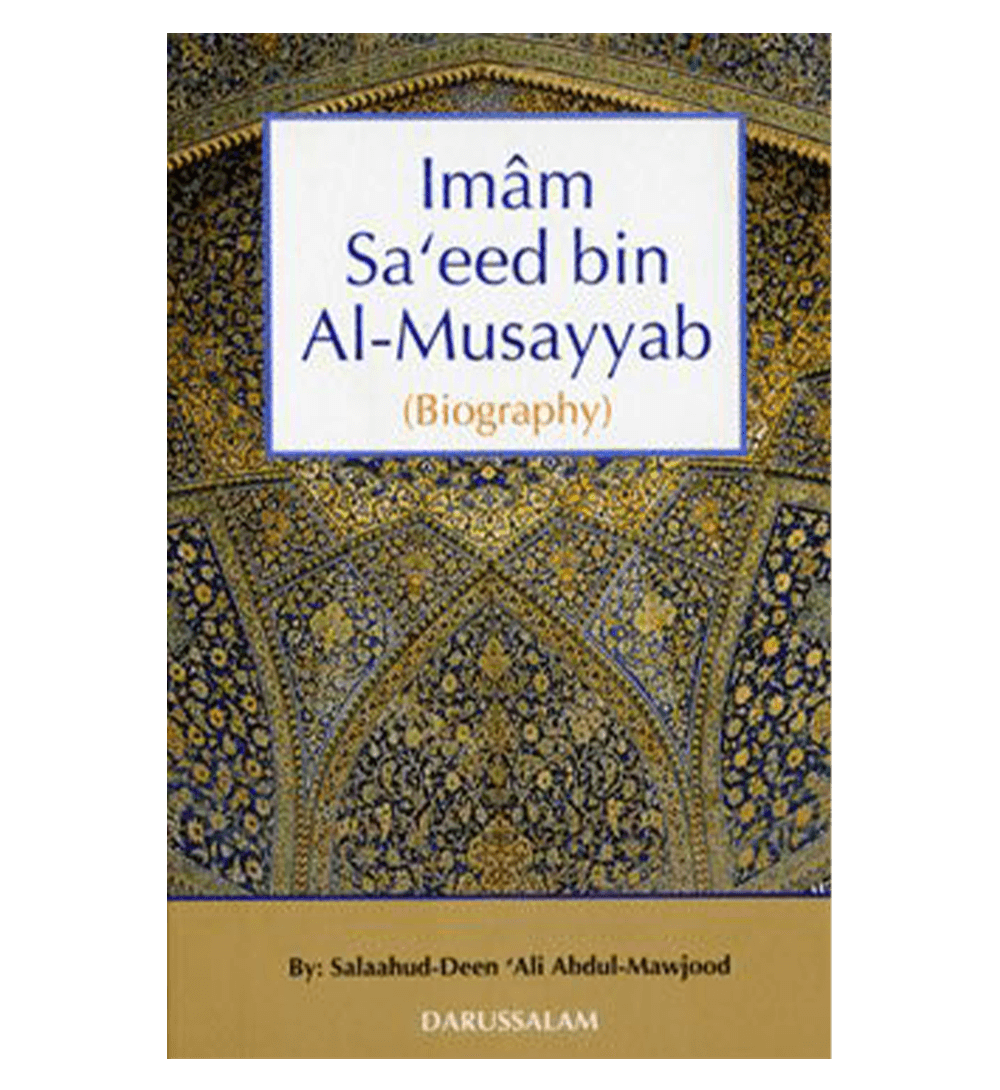
Imam Sa’eed bin Al-Musayyab: Biography
Review by Abdul Hai
There is a well-known prophetic tradition in which the Holy Prophet (may Allah’s peace and blessings be upon him) said:
“The best people are those of my generation, then those who come after them, and then those who come after them.”
For Muslims, this shows a clear imperative to derive religious understanding from these early generations of Muslims. Imam Sa‘eed ibn al-Musayyab, who was born fifteen years after the Hijrah and witnessed the leadership of ‘Umar ibn al-Khattab and those that came after, falls within this period praised by the hadith. As such, he represents, in accordance with the hadith, an exemplar from among the best generations whose life and scholarship merit careful study and emulation by later generations.
The biography of Imam Sa‘eed ibn al-Musayyab, published by the well-known Islamic publishing house Darussalam, forms part of a broader series dedicated to the lives of prominent Muslim scholars. The purpose of this series is to introduce English-speaking audiences to the intellectual and spiritual contributions of leading figures from the early Muslims. The work is authored by Shaykh Salaahud-Deen Ali Abdul-Mawjood, based on earlier biographical writings. In particular, the work is based upon Imam Shams al-Deen al-Dhahabi’s Siyar A‘laam al-Nubalaa. By collecting material from multiple classical sources, the author presents a relatively holistic portrait of Imam Sa‘eed, and it is translated into English by Ustadh Abdul-Raafi Adewale Imam.
The life of Imam Sa‘eed ibn al-Musayyab becomes especially important in our fast-moving and increasingly artificial modern world, since it offers a corrective lens through which we may rediscover a more grounded, rigorous, and distinctly Islamic worldview. His life exemplifies a mode in which religious principles are not abstract but lived realities. Imam Sa‘eed emerged from a deeply scholarly and devout family. His father, al-Musayyab, was an established faqeeh of Islamic law and was among those who pledged allegiance to the Holy Prophet (may Allah’s peace and blessings be upon him) under the tree. Such a distinguished lineage places Imam Sa‘eed within a tradition of knowledge, piety, and historical importance.
In line with classical Arabic biographical conventions, the book traces the Imam’s genealogy and briefly discusses notable members of his family, including his father and grandfather, but this aspect of the work remains somewhat limited and, at times, lacks depth. While it provides a useful introduction, it does not fully explore the subject in much detail. The main body of the book consists of over ten chapters, each divided into numerous subchapters. These sections collectively form the core content. The author adopts a methodical approach, often introducing a topic and then examining relevant narrations or scholarly discussions in a rather limited way. For instance, in the subsection entitled “Did he (Imam Sa‘eed) hear from ‘Umar?”, the author examines various reports to determine whether such transmissions are authentic. This style is maintained throughout, covering a wide range of themes, including the Imam’s pursuit of knowledge, his creed, his legal judgements, his physical characteristics, his intellectual abilities, and his relationships with both scholars and rulers.
More broadly, the life of Imam Sa‘eed, as presented in the book, offers valuable insight into both his personality and the worldview of his contemporaries. It reflects a life deeply rooted in Islamic identity and shaped by adherence to prophetic guidance. It underscores the idea that Islam is not confined to the private sphere or limited to cultural expression. Rather, it constitutes a comprehensive way of life encompassing social, political, and economic dimensions, as well as fostering a sense of global brotherhood and faith-based allegiance that transcends the artificial boundaries in which the Muslim world finds itself. This perspective also informs the Imam’s stance on political authority. While Imam Sa‘eed generally maintained that rebellion against rulers was not permissible within Islamic law, he firmly held that obedience must remain within the limits of the Shari‘ah. As highlighted by the author, this demonstrates a principled and balanced position rooted in an authentic Islamic legal framework.
In contrast, the relationship between many contemporary Muslim rulers and so-called scholars appears deeply problematic. In both the Muslim world and the West, there exist figures who align themselves closely with political authority and who openly transgress the Shari‘ah, often under the guise of promoting self-purification or localised engagement, while neglecting pressing issues affecting the wider Muslim Ummah. The book illustrates that Imam Sa‘eed was not such a figure; rather, he was a man of integrity and conviction, firmly grounded in Islamic principles. This stands in stark contrast to many contemporary voices who, through silence or compromise, contribute to what may be described as a subtle secularisation of Islam. In this sense, the book serves not only as a historical account of the Imam’s biography but also as a reflective and corrective text for the current generation, especially for the neo-traditionalist school, since in my view their approach to Islam seems more in line with a Eurocentric worldview rather than concerned with the well-being of the global Ummah.
The book is certainly an important work and deserves a place in the library of every Muslim; for this, the author should be commended. However, it suffers from several issues related to language, layout, and overall presentation, which detract from its potential benefit for the English-speaking audience. Firstly, much of the book appears to be a direct translation of Arabic material into English. Large portions of the book consist almost entirely of narrations, including the chains of transmitters, which may hold significance for the Arabic reader but carry little meaning for an English audience.
Secondly, some of the stories presented seem incomplete from the perspective of an English reader, leaving gaps in understanding. Thirdly, there is little to no commentary or explanation of the narrations to provide context or guidance on their interpretation. As a result, the book may only be fully appreciated by students of Islamic sciences, who are accustomed to this style of presentation. For the average reader, the book may be difficult to engage with, despite its importance. The translator could have achieved the aims of the work while using modern English and avoiding the inclusion of full chains of narration. While these chains have their place in classical texts, this translation is not the appropriate place for them. In conclusion, the book is much needed and valuable, but it requires major revision to reach its full potential. Until such improvements are made, the current edition remains recommended.