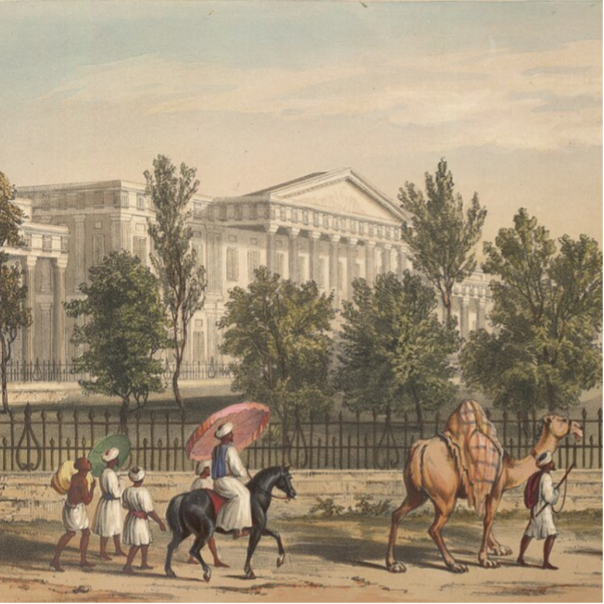
The Calcutta Madrasa and the Linguistic Problem of Muslim Education in Bengal
by Adnan Mahmud
In 1919, the Calcutta University Commission (the Sadler Commission) paused in the middle of its sprawling survey of Bengali higher education to issue a quietly devastating verdict on a decision made sixty-two years earlier. Had the Calcutta Madrasa been incorporated into the new Calcutta University at its founding in 1857, the Commission observed, “the whole subsequent history of the problem of the education of the Mussalmans of Bengal might have been different” (Ali 1971, 184). It is the kind of sentence historians live for: a colonial commission, not given to drama, conceding that a single administrative omission may have shaped the trajectory of an entire community for three generations.
The standard story of why the Calcutta Madrasa failed and why Bengali Muslims fell so catastrophically behind in colonial education runs along two familiar grooves. The first blames the colonial state: Macaulay’s 1835 minute, the abolition of Persian in 1837, the exclusion from the new university in 1857, the long indifference until Lord Mayo’s resolution of 1871. The second blames the community itself: the conservatism of the moulvis, the sharafatnama gatekeeping that kept the Madrasa an elite preserve, the refusal of the ashraf to send sons to schools they suspected of Christianising intent. Both stories are true. Neither is sufficient. What both miss is that the institutional question (should the Madrasa be inside the university?) was inseparable from a linguistic question that nobody was prepared to ask honestly: which Bengali, and whose Bengali, was the “vernacular” the system kept insisting Muslims should embrace?
The 1857 Hinge
To see why the missed affiliation mattered, it helps to look across the Indus. In 1882, when the Punjab University was constituted, it did something the Calcutta University had refused to do a quarter-century earlier: it created a Faculty of Oriental Learning that recognised Arabic madrasas, allowed their students to sit university examinations after passing supplementary English papers, and, in effect, threaded the existing Islamic educational infrastructure into the modern university system. The result was immediate. As Syed Murtaza Ali notes, “during the first ten years from 1882 Punjab University produced many Muslim Graduates” (Ali 1971, 195).
Bengal, by contrast, did the opposite. Sir Charles Wood’s Despatch of 1854; the founding document of the modern Indian university system; had explicitly recommended that “Mohammedan Madrassahs” be included among the institutions worthy of affiliation (Ali 1971, 184). When the University was actually established three years later, this recommendation simply evaporated. Neither the Calcutta Madrasa, nor the Hooghly Madrasa, nor any of the institutions that the community itself recognised as its educational backbone, was brought into the system: they were left to wither outside it.
Why? Ali suggests the rationale was punitive in a soft way: deprived of any worldly prospect, surely the Muslims would abandon their Madrasas and flock to English schools like the Hindus had done (Ali 1971, 184). It was a colossal misreading. The Muslims did not abandon the Madrasa system. They remained loyal to it precisely because, as Hunter would later observe, the new English system “makes no provision for the religious education of the Mohammedan youth” (quoted in Ali 1971, 186); and religion, for them, was not an optional add-on but the organising principle of education itself. The Madrasa, even as it stagnated, retained its legitimacy. What it lost was its connection to employment, advancement, and the broader intellectual life of the colony; it became, in Ali’s blunt phrase, “a blind alley leading nowhere” (Ali 1971, 184). They remained loyal to it precisely because, as Hunter would later observe, the new English system “makes no provision for the religious education of the Mohammedan youth” (quoted in Ali 1971, 186); and religion, for them, was not an optional add-on but the organising principle of education itself. The Madrasa, even as it stagnated, retained its legitimacy. What it lost was its connection to employment, advancement, and the broader intellectual life of the colony; it became, in Ali’s blunt phrase, “a blind alley leading nowhere” (Ali 1971, 184).
This is the institutional argument at its strongest. But it is not the whole story, and Ali himself, almost in spite of his framing, gives us the evidence for why it is not.
The Vernacular That Wasn’t Theirs
Here is the puzzle. If the Muslims’ grievance was simply that English education ignored their religion, why did they not embrace Bengali-medium education, which at least offered a path to literacy and modest employment? The answer, buried in paragraph 32 of Ali’s article, is one of the more remarkable observations in the literature, and it deserves to be unburied.
Through the combined efforts of the Baptist missionaries at Serampore (William Carey and Joshua Marshman, for instance) on one side, and the pandits of the Fort William College on the other, “the whole character of the Bengali language was changed.” It was denuded of all words of Arabic and Persian origin. These were replaced by words borrowed from Sanskrit having Hindu ideology and mythology” (Ali 1971, 193). The Bengali that emerged from this early-nineteenth-century laboratory (specifically the language of the textbooks, the schools, and the courts) was not the Bengali that Muslim peasants in Mymensingh or Chittagong actually spoke. It was a constructed register, deliberately purged of the Perso-Arabic vocabulary that had threaded through eastern Bengali speech for five centuries of Muslim rule.
Think about what this means. When the colonial state told Bengali Muslims that they should educate their children in the “vernacular,” it was telling them to learn a language that had been manufactured, in part, by people with no interest in their cultural survival, and stripped of precisely the vocabulary that connected them to their religious and literary inheritance. The Banglapedia entry on the Calcutta Madrasa captures the sting in a single phrase: Bengali was “despised as the ‘language of idolatry’“ (Banglapedia, “Calcutta Madrasa, The”). One can dismiss this as obscurantism, but one should at least notice what is being despised. It is not the spoken tongue of the Muslim peasant. It is the printed, Sanskritised standard of the missionary press and the Calcutta intelligentsia.
Hunter, with his characteristic mixture of sympathy and condescension, identified three instincts the system trampled. The new schools conducted education “in a language which the educated Mohammedan despises, and by means of Hindu teachers whom the whole Mohammedan community hate”; they failed to teach the Arabic and Persian necessary “for the performance of his religious duties”; and they made “no provision for the religious education of the Mohammedan youth” (quoted in Ali 1971, 186). The first of these (i.e., the language complaint) is usually folded into the second and third, treated as a kind of communal prejudice. It was not. It was a precise observation about what had happened to written Bengali in the previous fifty years.
The textbook problem made the linguistic alienation concrete. Nawab Abdul Latif and Nawab Ali Choudhury both drew attention to how Bengali school texts contained “many misrepresentations and libellous attacks on the Muslims” (Ali 1971, 196). The Reverend Adams had, with some prescience, recommended back in 1835 that special textbooks be prepared “to suit the Muslim taste” (Ali 1971, 193). It took until the end of the century for the recommendation to be acted upon, and Ali notes, with the calmness of someone delivering a thesis, that once it was, “Muslims then took to English education without any hesitation” (Ali 1971, 193). The conservatism, in other words, had been substantially a response to specific textual hostility, not a generalised refusal of modernity.
The Urdu Detour
The Muslim elite’s response to this linguistic dispossession was, in retrospect, a strategic disaster. Rather than fight for a de-Sanskritised Bengali (a Bengali that retained its Perso-Arabic vocabulary and its actual demographic ground) the ashraf leadership of Calcutta and Dacca turned to Urdu. Abdul Latif, Ameer Ali, Salimullah: each of these figures, indispensable to nineteenth-century Bengali Muslim history, treated Urdu as the proper language of Muslim cultural life. At Abdul Latif’s Mohammedan Literary Society, Ali drily notes, “speeches were delivered in English, Urdu and Persian. Nobody however spoke in Bangali” (Ali 1971, 196).
The demographic mismatch was extraordinary. Citing Titus Oates, Ali reports that at the beginning of the twentieth century there were roughly 2.22 crore Bengali-speaking Muslims in Bengal against 18 lakh Urdu-speakers; a ratio of more than twelve to one (Ali 1971, 196).The leadership was advocating for a language spoken by less than a thirteenth of the community it claimed to represent. Why? Ali, who is unusually frank about this, points to an inferiority complex: most rural Bengali Muslims were descendants of converts from Hindu and Buddhist backgrounds, but the elite preferred to claim descent from “Turks, Afghans and Persians who had come as conquerors” and to mark that descent linguistically (Ali 1971, 196).
The Calcutta Madrasa sat in the middle of this confusion, and its admissions policy made the elite alignment institutional. The Anglo-Persian Department, opened in 1854, restricted admission by demanding a sharafatnama: a certificate of high birth (Banglapedia, “Calcutta Madrasa, The”). The institution that was nominally the engine of Muslim educational uplift was constitutionally designed to serve the very class whose linguistic preferences had least to do with the actual lives of Bengali-speaking Muslims. The rural cultivator in Faridpur or Noakhali, who spoke a Bengali full of Arabic and Persian loanwords and whose religious life was conducted in a familiar idiom, had no institution speaking to him. The Madrasa addressed the Urdu-speaking ashraf. The new English schools addressed the Sanskrit-trained Hindu bhadralok. The largest Muslim community in the subcontinent fell into the gap between.
The Half-Correction of 1914
The Reformed Madrassah Scheme of 1914 did, eventually, what Wood’s Despatch had recommended sixty years earlier and what Punjab had quietly done in 1882. Drawn up by a committee that included Nawab Ali Choudhury, Nawab Sirajul Islam, and the Lucknow scholar Shibli Numani, the scheme aimed, in the words of Saghir Hasan, “to combine Western Education with Arabic learning and to bring about a synthesis of the old Madrassah system of education and that of modern universities” (quoted in Ali 1971, 198). Madrasa students could now sit university examinations. The institutional wall came down.
This was the correction of the 1857 mistake. It was also a correction that addressed only half the original problem. The Reformed Madrassah Scheme could connect Arabic-Persian learning to the English university. It could not undo the Sanskritisation of written Bengali, nor reconcile the ashraf’s Urdu attachment with the demographic reality of a Bengali-speaking Muslim peasantry. Those questions would have to wait; and when they finally erupted, they erupted in forms the 1914 reformers would not have recognised: in the language movements of the 1940s, in the Dhaka of 1952, and in the eventual fracture of Pakistan along precisely the linguistic fault line that the colonial Madrasa system had failed to address.
Conclusion
The Calcutta Madrasa’s failure was overdetermined; that is the easy part. The harder part is seeing how the institutional story (exclusion from the university, course rigidity, declining enrolments) and the linguistic story (a Sanskritised Bengali, an Urdu-oriented elite, a rural majority left without a vehicle) were not parallel grievances but the same grievance in two registers. The 1914 Reformed Madrassah Scheme could fix the visible problem because it was a problem of administrative architecture, and administrative architecture is the kind of thing colonial states are good at correcting once they decide to. The invisible problem (what language educates a community, and who gets to decide its vocabulary) could not be solved by an affiliation order. It had to be lived through, fought over, and, in the end, paid for in a currency the Sadler Commission would not have imagined.
When the Commission wrote that history “might have been different” had 1857 gone otherwise, it was right, but in a narrower way than it realised. The institutional history might indeed have been different. The linguistic history, one suspects, would have arrived at much the same place; though perhaps with fewer dead along the way.
References
Ali, Syed Murtaza. 1971. “Muslim Education in Bengal 1837–1937.” Islamic Studies 10 (3): 181–199.
Banglapedia: National Encyclopedia of Bangladesh. “Calcutta Madrasa, The.” Last modified 9 July 2021. https://en.banglapedia.org/index.php/Calcutta_Madrasa,_The
Featured Image
The Calcutta Madrasah in 1848. A lithograph by Sir Charles D’Oyly showing the first educational institution established in British India. (Source: Purono Kolkata)