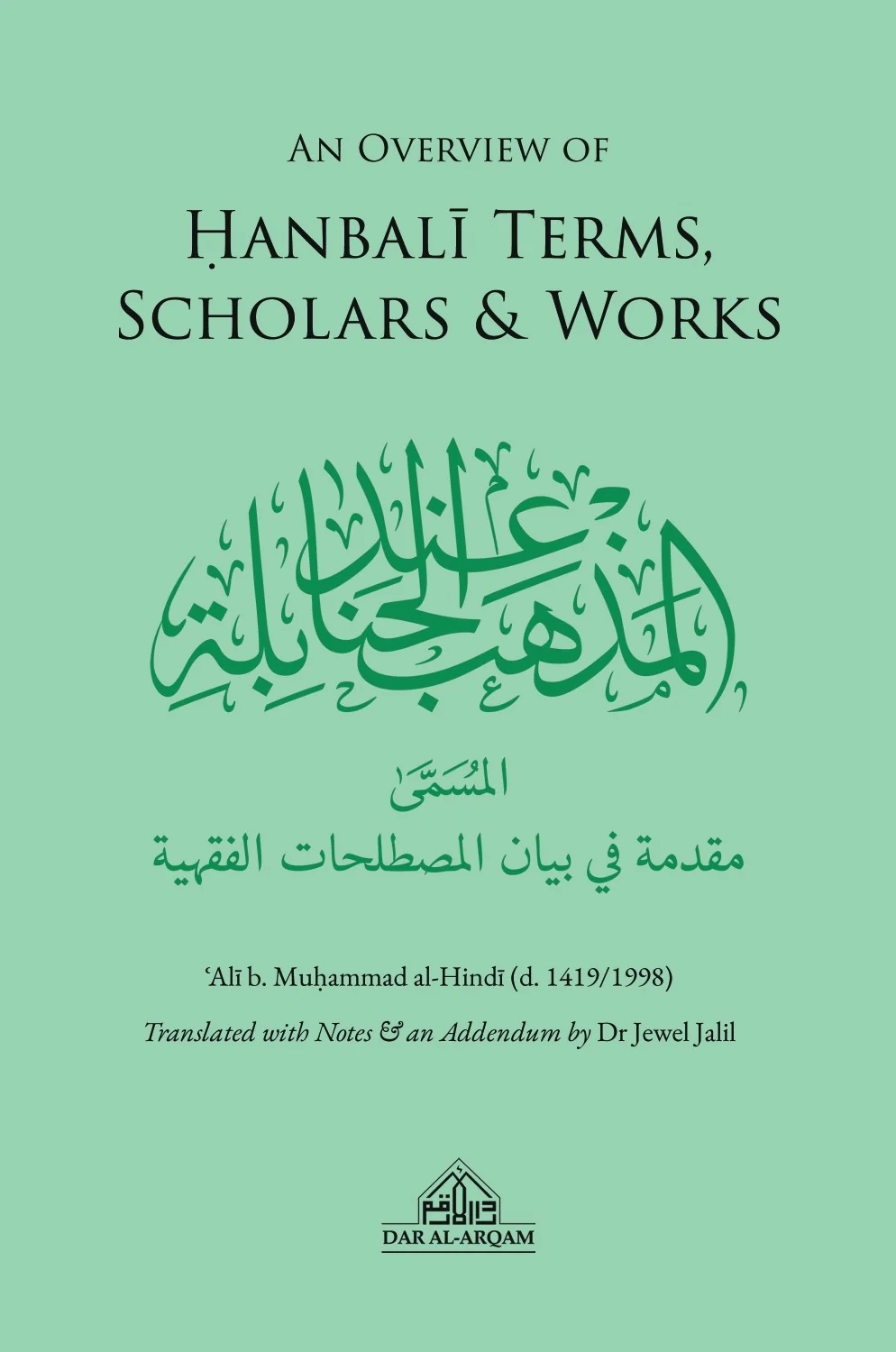
An Overview of Hanbali Terms, Scholar & Works By Shaykh Ali bin Muhmmad Al-Hindi
Reviewed by Abdul Hai
Professor George Makdisi, in his article “The Significance of the Sunni Schools of Law in Islamic Religious History,” observes that “one of the more interesting phenomena in Islamic religious history is the development of the schools of law.” This observation is indeed correct. The development of Islamic legal scholarship brought about a revolutionary understanding of the legal system, one that remains unmatched by any other socio-religious legal entity. The sheer volume of work produced by Muslim scholars, even at the level of individuals, is remarkable.
Early Islam witnessed the emergence of numerous legal schools, many of which declined due to various social and political factors. The four Sunni legal schools namely the Hanafi, founded by Imam Abu Hanifa (d. 767); the Maliki, founded by Imam Malik (d. 795); the Shafi‘i, founded by Imam al-Shafi‘i (d. 820); and the Hanbali, founded by Imam Ahmad ibn Hanbal (d. 855) are those that have endured. The majority of the Muslim world now adheres to one of these legal schools, with the exception of the Shi‘i tradition, which maintains its own legal frameworks.
Over time, certain schools and their scholars became more established than others, owing to a range of factors, including political patronage. For instance, major Islamic empires such as the Ottoman and the Mughal Empires adopted the Hanafi school as their official legal tradition. This helps to explain why a significant proportion of Muslims adhere to the Hanafi school. The least widely followed school is perhaps that of Imam Ahmad ibn Hanbal. This can be attributed to various social and political reasons; however, a detailed examination of these lies beyond the scope of the present discussion. What can be stated with confidence is that the Hanbali school is now well established, and scholars across successive generations have affiliated themselves with it, adopting the appellation al-Hanbali as part of their scholarly identity. Like scholars of other legal traditions, they have produced a substantial body of work that codifies, explicates, and analyses legal opinions, contributing to the development of a rich intellectual tradition.
The book under review belongs to this body of Hanbali scholarship. It is authored by the more recent Hanbali scholar Shaykh Ali bin Muhammad al-Hindi (d. 1998) and is entitled Muqaddimat fi Bayān al-Mustalahāt al-Fiqhiyya (An Overview of Hanbali Terms, Scholars, and Works). It has been translated by the well-known scholar and translator Dr. Jewel Jalil. The book may be regarded as comprising three broad parts, each containing numerous sub-sections that collectively form the main body of the work. The first part; The introduction constitutes the smallest section, encompassing the customary elements such as the translator’s acknowledgements, methodological remarks, and, most notably, a concise biography of the author. The second part, which represents the principal portion of the text, is presented under the title Muqaddimat fi Bayān al-Mustalahāt al-Fiqhiyya.
This section may further be divided into two broader parts. In this regard, the first section provides the author’s introduction, in which he outlines the purpose of the book and the scholarly gap it seeks to address. Although brief, this section is of considerable importance, as it situates the work within a clear and concise framework. The author also attempts to provide a general overview of fiqh, covering the foundational principles common to all Sunni legal schools. This places the work within a broader context in relation to the other legal traditions and the primary sources upon which all schools including the Hanbali school base their legal understanding. For example, the author discusses the definition of fiqh, its sources, themes, and benefits. This enables readers from diverse backgrounds to better comprehend the material addressed later in the work. It also allows the reader to situate the Hanbali legal school alongside the other Sunni legal traditions and to recognise their shared intellectual roots, rather than perceiving them as entirely separate or disconnected from one another.
An important aspect of this section is the discussion concerning the codification of the Hanbali madhhab and the specialised terminology employed in Hanbali legal manuals. This discussion is particularly valuable, as the Hanbali school, like the other legal schools, developed its own distinctive terminology and methodologies that operate within its scholarly tradition. Indeed, this marks the point at which the book begins to immerse the reader more deeply into the world of Hanbali scholarship. From this stage onwards, the discussion becomes more focused upon the Hanbali school and its scholarly tradition. The work then proceeds to divide Hanbali scholars and scholarship into three generational periods. The first is the early generation, extending from 241 AH to 403 AH; the second is the middle generation, spanning from 403 AH to 884 AH; and the third is the later generation, beginning from 885 AH and continuing to the present day.
Following the discussion of each generation, the author includes a separate section outlining the authoritative legal positions adopted by that particular generation in representing the official stance of the Hanbali school. In these sections, the principal scholars and their major works are identified, together with an explanation of which Hanbali legal manuals are granted precedence over others. The author also clarifies which scholars and works are considered most authoritative when differences of legal opinion arise within the school. These concluding sections, which appear after the treatment of the early, middle, and later generations respectively, are particularly beneficial to the reader. After presenting the various scholarly opinions and legal positions advanced throughout each period, the author provides a concise summary of the legal position ultimately adopted by the school. In this way, the reader is able to distinguish between individual scholarly views and the official position of the Hanbali madhhab. This is especially important in enabling the reader to follow clearly the historical development and internal evolution of Hanbali legal scholarship.
The third part, authored by Dr Jewel Jalil, appears under the heading “Addendum: The Later Generation and the Development of the Mu‘tamad Opinions” and serves as an excellent supplement to the main work. As Dr. Jalil himself notes, this section provides “an overview of the historical development and the concept of the official opinion (mu‘tamad) among the later generation.” In this section, the translator summarises the three generations discussed previously and examines, in some detail, the differing approaches each generation adopted in formulating the official legal position of the Hanbali school. Furthermore, he highlights specific case studies in order to demonstrate the practical functioning and methodological mechanisms of the school. This addition significantly enhances the reader’s understanding of how authoritative opinions were developed, refined, and ultimately established within the Hanbali legal tradition.
At this point, Dr. Jalil is to be congratulated for producing a very important translation that will assist the growing number of students who are showing increasing interest in the development of, and adherence to, the Hanbali school of Islamic legal thought. However, this book remains aimed at introductory students of Islamic studies. It may or may not be the first text to be consulted in order to understand Islamic law itself; nevertheless, it is an important work for gaining an initial understanding of the Hanbali legal school.
One of the principal calls of the Salafi movement, a movement that I greatly appreciate and to which I attribute much good, particularly in reviving the importance of hadith within the lives of Muslims is the call to avoid strict adherence to a particular legal school. However, with the passage of time and experience, I have come to the conclusion that such a call was not always necessary and, in certain cases, has contributed to greater disorientation, especially amongst Western Muslims. I do not state this out of contempt for the movement or its scholars, for whom I continue to hold considerable respect. Rather, I say this because the reality is that the study of any discipline, particularly Islamic legal studies, requires structure and methodological coherence. The study of a legal school provides such structure and enables the student to develop within a legal tradition in a holistic manner, fostering an understanding that is balanced, nuanced, and appreciative of the broader scholarly heritage.
In a globalised world, where information travels faster than thought itself, it has become increasingly important for individuals particularly those in the West to adhere to a recognised legal tradition, at least during the early stages of their educational journey. Such adherence facilitates unity, strengthens one’s connection to the early scholars, and, most importantly, revives engagement with the works of the classical jurists. These works are essential in shaping a coherent modern legal worldview and in resisting the growing secularisation of legal systems that is taking place across much of the Muslim world. For me personally, the natural transition from not following a legal school to adopting one was towards the Hanbali school. Although my limited knowledge does not permit me to adopt the appellation al-Hanbali, it is nevertheless a journey upon which I have embarked, however, for now, whenever an issue arises requiring legal guidance, my local imam remains my principal source of reference, irrespective of the legal school to which he may or may not adhere. This is because I am obligated to consult the people of knowledge, as Allah, Most High, states:
فَسْـَٔلُوٓا۟ أَهْلَ ٱلذِّكْرِ إِن كُنتُمْ لَا تَعْلَمُونَ
“So ask the people of knowledge if you do not know.”