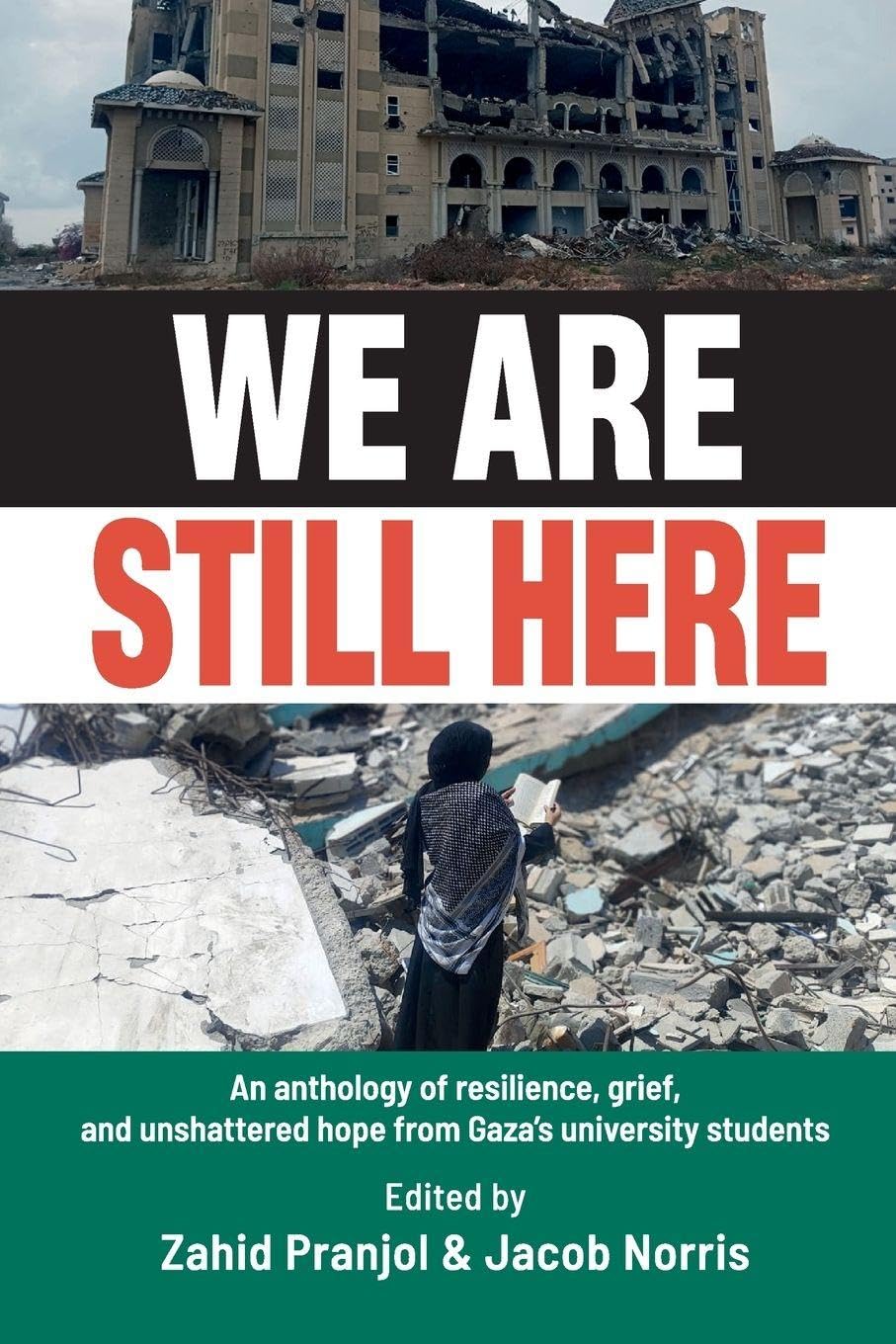
We Are Still Here: An Anthology of Resilience, Grief, and Unshattered Hope from Gaza’s University Students
Edited by Zahid Pranjol and Jacob Norris.
Reviewed by Abdul Hai
سْمِ ٱللهِ ٱلرَّحْمَٰنِ ٱلرَّحِيْمِ,
Never have I been so of two minds about a book and its contents as I am about We Are Still Here: An Anthology of Resilience, Grief, and Unshattered Hope from Gaza’s University Students, edited by Zahid Pranjol and Jacob Norris. Part of me is glad that the book has been published, yet another part wishes that it had not. This confusion, these conflicting sentiments, do not stem from any shortcomings on the part of the publisher or the editors. Rather, they arise from the pain and suffering that persist in the world today. The uncertainty comes from trying to comprehend how, after humanity’s supposed progress towards enlightenment, such unimaginable suffering can still exist. How can there be, in the modern world, such brutality, such dehumanisation, such acts approaching genocide occurring openly, broadcast in real time for all to see?
It is this sense of disbelief that makes one wish the book had never needed to be written. It is the denial of the reality of human cruelty that makes one hope such a book did not have to exist. Yet reality is reality: pain and suffering endure; there are good people, and there are those who suppress their humanity and embrace evil. Recognising the existence of such “devils” among human beings compels us to reflect, to intervene, and to help redirect and restore hope, to engage in the work of healing and rehumanising. In this sense, the book is not only necessary but vitally important, and its publication and circulation are essential.
We Are Still Here is a compelling collection of writings by university students from Gaza, representing various stages of their academic journeys. As the title suggests, despite the destruction, genocide, hardship, hunger, and violence that surround them, these students continue to nurture hope, aspiration, and ambition. They pursue their education with the aim of contributing positively to the world.
The book vividly illuminates the struggles faced by students in Gaza while emphasising their unwavering commitment to learning. Even when their lives are shattered and their surroundings seem to offer only despair, they remain hopeful and motivated to study. A palpable energy emerges in the students’ narratives, reflecting a determination to rebuild their lives through education and a resilience that underscores their faith in a better future.
The volume is divided into two sections. The first, titled Reflections, comprises prose accounts in which the students recount their experiences, suffering, and personal insights. These narratives vary widely in style, perspective, and emotion, providing the reader with a profound understanding of what life is truly like in Gaza. The second section, titled Poems, presents a collection of poetic works by the students, rendered in their raw and unfiltered form. Through diverse viewpoints and emotional expressions, the poems offer readers a vivid and moving portrayal of both the real suffering and the remarkable resilience of Gaza’s youth.
Writing a book review generally follows a standardised method. However, in reading this book and attempting to write anything about it, I have found that adhering to a conventional review methodology is almost impossible. With every page I turned, every story of the students and people of Gaza that I read, tears flowed unbidden from my eyes. My heart seemed to beat violently in my chest; the sounds around me faded into muted silence. I found myself overwhelmed by hopelessness and disbelief.
For these reasons, a review of the standard kind is simply not possible. What follows, therefore, is not an academic critique in the conventional sense, but rather a sharing of the emotions that this book, its narratives, and its poems evoked in me—emotions which I believe the work itself seeks to elicit in every reader.
There is something undeniable about the people of Gaza in general, and the students in particular, who have expressed their emotions in this book. Their experiences transcend words; they defy ordinary expression. How is it possible for someone to write after witnessing the murder of their entire family? How can one endure seeing a father and brother blown to pieces while simply going out to buy bread? How does a mother bear the horror of picking up a child, not whole, but in two separate parts, severed by an Israeli bomb?
Yet, despite this unimaginable suffering, they take up the pen and write. They look towards the heavens and praise Allah, their faces marked by smiles that shine even in the darkest of circumstances. There is something in these people that transcends human experience. Their suffering is numbing; the pain is almost unbearable. And yet, they write with hope. They climb to the tops of buildings to access the internet so they can download university materials. They move from café to café, taking exams, achieving the highest grades, all while surrounded by devastation. For them, education carries a meaning beyond achievement; it is an act of defiance, a reclamation of humanity, and a testimony to resilience that goes far beyond what most of us can imagine.
Reading the stories penned by the students in this volume, one encounters voices at every stage of academic life some just beginning their journeys, others more experienced and mature. For them, education is not merely a pursuit; it is a vital and essential part of life, despite immense difficulties and a lack of resources. Even before 7 October, the students of Gaza appear to have found answers to the challenges they face. There is a remarkable positivity in their perspective, a belief that, amidst all the chaos, humanity will shine once more.
As I read these stories from the comfort of a chair, surrounded by warmth and love, I was struck by disbelief. How could such hope exist in the face of such suffering? Yet it is almost as if the students are speaking directly to the reader: life holds positivity and goodness, and it will continue to blossom, regardless of circumstances. In some sense, one feels sorrow—not for them, but for us, the readers, who may have lost hope in humanity or in the possibility of reclaiming human values.
Take, for example, the story of Nour Mohammed AbuSultan, entitled 2024. She writes:
“2024 stood between pain and hope, between loss and resilience. It taught me that no matter how harsh life becomes, there is always a flicker of light. My resilience was my strength, my hope my weapon. And I still believe that tomorrow will be more beautiful, and that flowers can bloom from ash.”
Pain and sorrow are forces intended to break even the strongest of people, to weaken the upright soul, and to cast a shadow over the clearest of minds. Yet, remarkably, the devastation inflicted upon the students of Gaza seems to have had the opposite effect. It has sharpened their ambitions, strengthened their determination, and elevated their resolve to an extraordinary level. The clarity with which they describe their pain and navigate their daily lives amidst chaos is astonishing. Each story in the book combines an acceptance of suffering with an unwavering refusal to allow it to numb the soul.
The students remain active and engaged at every turn, portraying a world in which hopelessness coexists with hope a “New Day,” as Lina Khattab describes in her story. She writes:
“This reality pains me, and it pains me even more that we are seen merely as human material, evoking pity. But here we are, warriors; we battle fear, we dream dreams larger than those we once held, and we live today with the courage to face an end…”
Her words, like many others in this volume, capture a remarkable resilience: the ability to acknowledge suffering without surrendering to it, and to pursue hope, freedom, and dreams even in the harshest circumstances.
The stories crafted by the students carry a sadness in their voices, a frustration with both their situation and the wider world. Yet, these brave souls never relinquish hope. Despite repeated tragedies, hardships, and darkness, Gaza and its people endure. This hope operates on two levels: first, it is hope for their own future, expressed through the stories and poetry they write; second, it extends to the readers, inspiring those outside Gaza to believe that suffering will not last forever. In this way, the narratives not only reflect the harsh realities of life in Gaza but also illuminate a path toward hope and resilience for both the writers and their audience.
The terrorist state of Israel has miserably failed in its aim to force the people of Gaza into submission. Likewise, the West, with its long-standing and often uncritical support, has also failed to take the pen from the hands of these young students, to stop them from telling their stories, or to blind the world to their suffering. Instead, what Israel and its Western allies have witnessed is a population that will never give up a people who will never surrender their land to a colonial entity.
In the poetry of Samah Mustafa Yousef Bashir, whose poem in this volume is titled “Between Hunger and Silence”, this spirit is powerfully captured:
“In Gaza
hunger does not breed submission.
It awakens the revolution from its sleep.
We will not die of hunger—
we will live as fire.
And when the world has had its fill of denying us,
we will be—
the new wheat
and the flame that cooks
the feast to come.”
Bashir’s words, like many in this collection, embody resilience, defiance, and hope. They testify to the enduring strength of a people who refuse to be silenced, despite unimaginable suffering.
Who is to be held accountable for the suffering of this land and its people, and for the cruelty inflicted by Israel and its Western allies? As a Muslim, such reflection must be internal, grounded in the Qur’an, the prophetic tradition, and the understanding of the early generations of Muslims. The Qur’anic worldview identifies behaviours aligned with human nature; thus, it is perhaps unsurprising that the Zionist entity, together with its Western allies, acts in ways that inflict harm and destruction, for such actions are consistent with their very nature.
Yet a greater responsibility lies with those who claim to adhere to Islam and profess a brotherhood rooted in shared faith but collaborate with these forces, thereby bringing suffering upon their own people. The Syrian poet Omar Abu Risha captures this truth poignantly:
“لا يُلام الذئب في عدوانه
إن يكُ الراعي عدوّ الغنمِ”
“The wolf is not to be blamed for its aggression
if the shepherd is the enemy of the sheep.”
There is no doubt that many rulers, particularly those in the Gulf States, have betrayed their fellow Muslims. By aligning themselves with the Zionist entity, they facilitate the killing of the people of Gaza and act as enemies to Muslims and to the development of a cohesive Muslim community. They do so at the expense of their fellow Muslims. These rulers must be held accountable, for they claim to belong to the House of Islam, yet at every turn they contribute to its destruction.
The greatest protectors of the Zionist state are not America; rather, it is the Muslim world, particularly the Gulf States. It is these states that enable the Zionist entity to carry out its genocidal actions with impunity. It is these same Gulf States that have betrayed their fellow Muslims, burning the House of Islam even as they claim to be its protectors. This is a reality that every ordinary Muslim must reflect upon.
If I were to recommend this book to anyone, I would suggest it to Jesse Watters, a host on Fox News, who appears to allow his racial and colonial prejudices to cloud his judgment. In a striking display of ignorance, he once claimed that the people of Gaza are “uneducated” and therefore a “threat.” This is particularly ironic given that the literacy rate in Palestine is among the highest in the region, at 98%. With his so-called Bachelor of Arts degree, he seems to have forgotten that Palestinians have long made significant contributions to literature, education, and culture even while his own ancestors were presumably still engaged in cave painting. It is remarkable, and indeed almost comical, how some individuals, emboldened by material advancement, presume to speak arrogantly about a nation whose heritage is as rich and enduring as that of the Palestinian people.