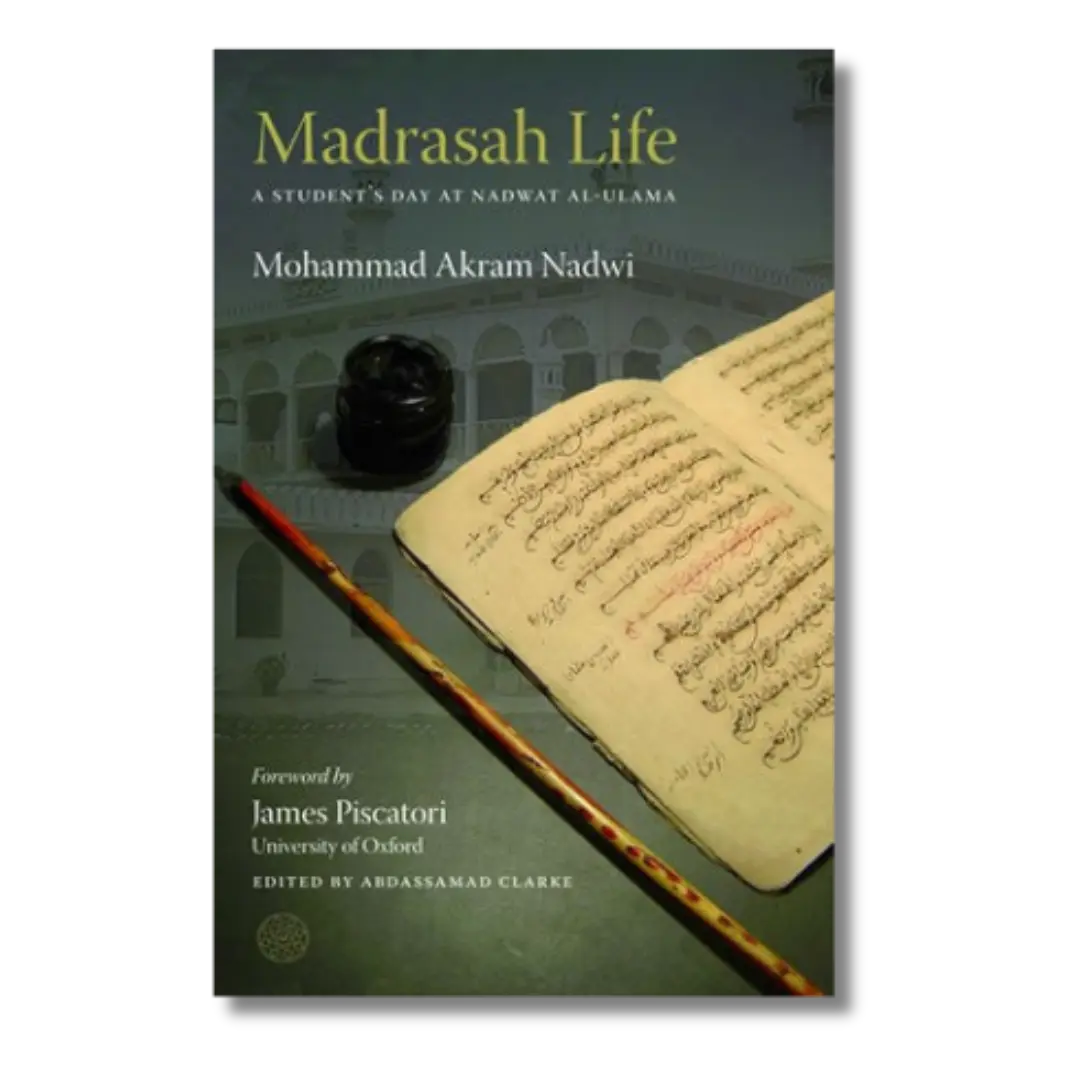
Madrasah Life: A Student’s Day at Nadwat al-Ulama By Mohammad Akram Nadwi
Reviewed by Abdul Hai
In the contemporary global landscape, the term “madrasah” has become a lightning rod for political debate and cultural war, often reduced to a caricature of religious isolationism, anti-process or, more darkly, a breeding ground for radicalism. Since the events of 9/11, Western policymakers have frequently viewed these traditional Islamic institutions through a lens of suspicion, calling for radical reforms to align them with “their understanding” of modern “mainstream” education. It is within this hostile atmosphere that Shaykh Mohammad Akram Nadwi’s Madrasah Life: A Student’s Day at Nadwat al-Ulama emerges as a vital, experience-based and intellectually rigorous corrective. Originally published in Urdu as Nadwe kā ek din, this memoir provides an unprecedented “participant observation” account of daily life at Dar al-Ulum Nadwat al-Ulama in Lucknow, India, one of the most prestigious centres of Islamic learning in the world.
Shaykh Akram Nadwi’s central thesis is that the madrasah is neither a rigid nor an outdated or a political entity, but rather a complex, intellectually demanding, and spiritually fulfilling environment. He presents the institution as a powerhouse of the Islamic world, a space in which the transmission of knowledge is cultivated alongside a profound sense of spiritual belonging. He, argues that institutions such as Nadwat al-ʿUlamāʾ are not irrational, rigid, or backward establishments often portrayed in contemporary Western discourse. Instead, they function as hubs of learning and as bridges between the traditional and the modern. Students who graduate from such institutions are no less knowledgeable or sophisticated than their counterparts in Western educational settings. Major-General Sir W. H. Sleeman observed after visiting madrasahs in India in the early nineteenth century, [those graduates] “could talk as fluently about Socrates and Aristotle, Plato and Hippocrates, Galen and Avicenna, as young men raw from Oxford”.
The author organises his narrative around a representative day in the life of a faḍīlah (Master’s-level) student, depicting a regimen that routinely exceeds twenty hours of study and devotional practice. This demanding schedule is complemented by references to extracurricular intellectual pursuits, such as open poetry readings, as well as social activities, including participation in the Shibi Badminton Club, of which the author is a member. The text offers a meticulous chronological account of the student’s day, beginning before the fajr prayer “I awoke at 5 a.m.”—and extending late into the night; as James Piscatori observes in his foreword, students at the madrasah “retire perhaps by 1:00 a.m.”
Beyond this temporal structure, the author offers detailed descriptions of the lessons attended by students, specifying the lectures undertaken, the subjects covered, and the scholars responsible for teaching each discipline. Within these lectures, instructors engage both classical authorities and contemporary academic scholarship, highlighting figures recognised as leading experts in their respective fields. Taken together, these elements provide the reader with a vivid and systematic insight into the intellectual life of the institution. By way of illustration, the author notes:
The first lesson, at 7:45 a.m. during the first period, is Hijjatuallah al-Balighahof Shah Waliullah Dihlawi, taught by Mawlana Burhan Al-Din Sambhali. The second lecture, at 8:45 a.m., is on Sharh Ma’ani al-Atharof Imam At-Tahawi, taught by Mufti Zahur. The third lecture, which begins at 9:30 a.m. and lasts for an hour and a half, focuses on Imām al-Bukhārī’s Al-Jāmiʿ al-Ṣaḥīḥand is delivered by Mawlānā Diya al-Hasan Nadwi.
The book may be understood as operating on multiple narrative levels, articulated through the author’s lived experiences. It offers insight into the author’s religiosity while conveying the affective atmosphere cultivated within a religious institution where intellectual activity is deeply embedded. In doing so, the text invites the reader to participate in the author’s emotional and spiritual experience, as shown by the following passage:
“After performing wuḍūʾ, I marvelled at the morning scene. It appeared as though angels were descending from heaven, blessing the believers with celestial touches and instilling God-consciousness.”
The book not only provides a unique window into the intellectual life of the author only but also detailing the experiences of his fellow students. It records lively exchanges and philosophical discussions, offering insight into their differing interests, perspectives, and approaches to learning. By recounting these interactions, the author situates his own experiences within the broader intellectual community of the institution, illustrating how students collectively engage in the development of knowledge and critical thought.
For example, he recounts a conversation between two of his fellow students, Ibrahim and Baba While Ibrahim demonstrates a keen interest in grammar, Baba shows little engagement with the subject. By recording such discussions, the author not only presents his own perspective but also vividly portrays the lives, attitudes, and intellectual dispositions of his peers. These portrayals reveal how students, to varying degrees, contribute to their own intellectual development as well as that of the institution. The author also gives considerable attention to the teachers and academic staffs, who work in the madrasah. Some aspects of the madrasah’s history are discussed to a certain extent. The scholars of the past who were associated with the madrasah are mentioned, along with their contributions and various associates.
One of the most distinctive features of this book is the author’s profound love of poetry in Arabic, Urdu, and Persian. Almost every page contains a line of verse, employed either to support the argument of a fellow student, to convey the emotions the author himself is experiencing, to illustrate the validity of a particular legal opinion, or to praise a scholar. The extensive use of poetry, drawn from multiple languages and readily quoted, reflects not only the author’s erudition and linguistic mastery but also the scholarly culture of the institution, including students, teachers, and academic staff. This demonstrates the rare ability of students to communicate at the highest literary level across several languages, creating a rich and creative intellectual environment. Such a portrayal challenges the common Western, and sometimes even internal, perceptions of madrasahs as being rigid or insular; rather, it reveals them to be institutions that are intellectually vibrant and, in many respects, surpass traditional Western educational models. For example, when the author reflects on the dawn prayer, its timing, and the call to prayer, the sound of the water evokes for him the poetry of the Indo-Pak poet, philosopher, and political thinker Allama Iqbal. He cites Iqbal’s line in which the poet states:
“It is couched in this parable: one night the morning star asked the stars whether man is ever awake. To this, each star responded in its own way. At that moment, the adhan was sounded, which adequately answered the question, for the call to prayer is a message and an invitation that overthrows all falsehood.”
The present reviewer does not consider himself fully capable of critically assessing the author. Nevertheless, were one to suggest an area for potential enhancement, it would be the inclusion of a chapter comparing the institution he describes with other madrasahs around the world. Many such institutions fall far short of the academic rigour, intellectual standards, and level of study exemplified by Nadwat al-Ulama. Regrettably, most madrasahs lack genuine engagement with either substantial knowledge or critical thinking. Adding such comparative analysis, offering a critical perspective on institutions that fail to meet these standards, would have made the book even more complete- As Allama Iqbal poignantly observes in one of his couplets:
I left the madrasa and the monastery in sorrowFor there was no life, no love, no wisdom, no vision.
This observation underscores the gap between institutions that merely exist in name and those, like Nadwat al-Ulama, that genuinely cultivate both religious and worldly knowledge.