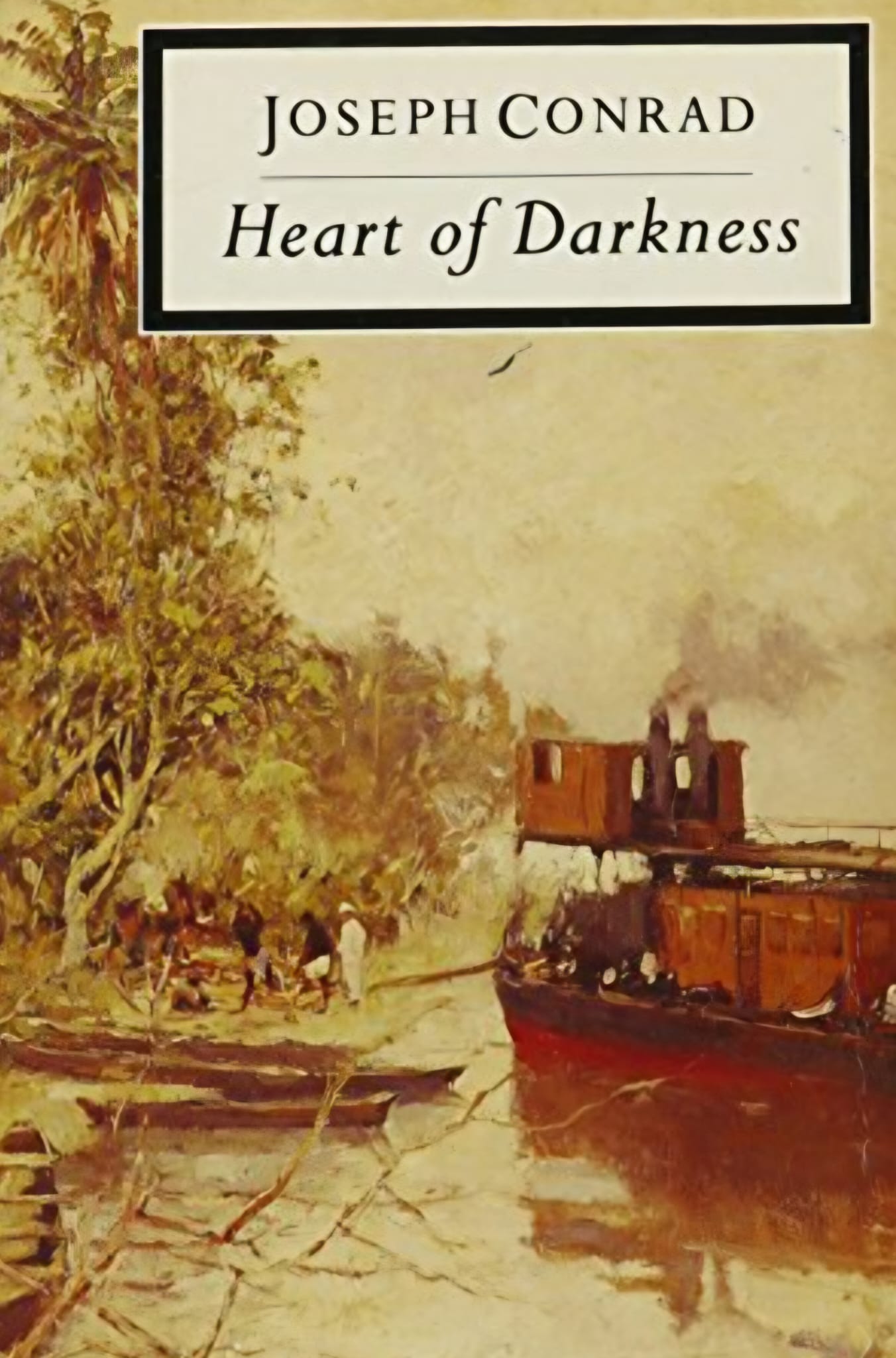
Heart of Darkness by Joseph Conrad
Reviewed by Abdul Hai
Heart of Darkness by Joseph Conrad, first published in 1899, is a novella about Charles Marlow, a sailor who travels deep into the Congo in Africa to work for a European ivory-trading company. The story begins with an unnamed narrator recounting Marlow’s story to a group of men who are sitting together on a boat named Nellie, which is anchored on the River Thames in England. As Marlow travels deeper into the Congo, he constantly hears about a character called Kurtz, who can be considered the central figure of the story. Kurtz is a highly complex character, and the novel creates a portrayal of him as someone who is a brilliant and gifted man, an idealist, a successful ivory trader, and a charismatic individual. However, Kurtz is also portrayed as a tyrant and a morally corrupted figure. These characteristics are highly significant and will be explored in greater detail below.
Marlow discovers and witnesses, throughout his journey, the brutality of European colonialism, including the exploitation, imprisonment, killing, and dehumanisation of African people, who were treated as inferior to Europeans. For most of the novel, Marlow only hears accounts of Kurtz and his extraordinary qualities, which gradually transforms Kurtz into an almost mythical figure. Eventually, Marlow encounters Kurtz towards the end of the novel after arriving in the Congo and joining the Company’s Outer Station. From there, he travels to the Central Station and, after several months of further exploration, reaches the Inner Station, where Kurtz is stationed and where he finally meets him. Kurtz is extremely ill, yet he remains authoritative and continues to exert enormous influence over the local population. His physical condition deteriorates gradually, and he eventually takes his final breath with the words, “The horror! The horror!” upon his lips.
Marlow develops two contrasting perceptions of Kurtz: one of admiration for his intelligence, eloquence, and charisma, and another of contempt for his cruelty, corruption, and moral collapse. Marlow eventually returns to Europe; however, his journey into the Congo profoundly changes his understanding of civilisation and causes him to question the European claim of moral and cultural superiority. Although the novel is relatively short, ranging between 90 and 110 pages depending on the publisher, it has received significant attention from scholars, writers, and literary critics. Some have praised it as an anti-colonial novel that exposes the brutality of imperialism, while others have argued that the text remains influenced by the colonial worldview it appears to criticise.
Chinua Achebe, in his influential essay “An Image of Africa: Racism in Conrad’s Heart of Darkness,” criticises the novel by arguing that Conrad’s opposition to colonialism is almost undermined by his portrayal of Africa. Achebe argues that Conrad continues to present Africa as a place of darkness and as “the other world”, while offering a dehumanising representation of African people. Achebe highlights passages such as:
“…upon my word, to look at him was as edifying as seeing a dog in a parody of breeches and a feather hat, walking on his hind legs.”
Achebe argues that such descriptions reveal the persistence of racial assumptions within Conrad’s narrative. Cedric Watts, in his article “A ‘Bloody Racist’: About Achebe’s View of Conrad”, presents a contrasting interpretation, viewing Conrad as an anti-colonial writer who exposes and criticises European brutality, hypocrisy, and attitudes towards colonised peoples. A more balanced interpretation has been offered by scholars such as Edward Said in Culture and Imperialism. Said acknowledges that Conrad was a product of his historical period and that his worldview was inevitably shaped by the imperial context of nineteenth-century Europe. However, Said also argues that Conrad demonstrated an extraordinary degree of self-awareness for his time. This self-awareness may represent Conrad’s attempt to reveal the contradictions and moral failures of imperialism.
Regardless of one’s interpretation of Conrad’s personal beliefs and worldview, one historical reality remains undeniable: European colonialism was a violent and oppressive system. History records numerous examples of colonial powers committing acts of extreme brutality against indigenous populations, exploiting human beings in ways that caused suffering on a vast scale. Conrad himself states, while referring to Kurtz, that “All Europe contributed to the making of Kurtz,” suggesting that Kurtz represents not merely an individual but a wider symbol of European imperialism. Kurtz’s qualities’ his brilliance, intelligence, idealism, success as an ivory trader, and almost intoxicating charisma inspire admiration among many people, including the local population. Through such qualities, figures like Kurtz were able to establish authority while simultaneously claiming a supposed moral superiority and a civilising mission.
This belief in imperial responsibility was reflected in European political discourse. On 13 June 1910, the Prime Minister Arthur James Balfour delivered a speech in the British Parliament that demonstrated how the qualities associated with Kurtz’ confidence, intelligence, and imperial idealism appeared in the real-world justification of colonial rule:
“Is it a good thing for these great Nations – I admit their greatness – that this absolute government should be exercised by us? I think it is a good thing. I think that experience shows that they have got under it a far better government than in the whole history of the world they ever had before.”
Such language demonstrates how European imperialism often relied upon persuasion, diplomacy, and claims of benevolence. However, beneath this image of civilisation existed another reality: violence, tyranny, exploitation, greed, and the destruction of human lives. This darker side of Kurtz also reflects European imperial history. European interactions with many parts of the world frequently resulted in colonisation, exploitation, and violence against indigenous populations. King Leopold II of Belgium, for example, presented his rule over the Congo Free State from 1885 onwards as a humanitarian project, yet in practice his regime resulted in forced labour, widespread suffering, and the deaths of millions of Congolese people.
Similarly, the East India Company, established in 1600, initially presented itself as a commercial organisation focused on trade but eventually became a powerful colonial institution that contributed to the political domination and exploitation of India. The consequences of British colonial rule included devastating events such as the Bengal Famine of 1943, during which millions died and Winston Churchill’s response to the famine was to describe Indians as “a beastly people with a beastly religion”.
Although Kurtz is physically dying, the ideology that he represents is not. His final moments do not necessarily signify the death of imperial thought; rather, they invite readers to reflect on the continuing legacy of colonialism in the modern world. In this sense, Kurtz can be understood as a symbol whose influence extends beyond the nineteenth century. This continuing debate is illustrated by Bruce Gilley’s article, The Case for Colonialism (2017). Gilley argues that Western colonialism produced significant benefits and contends that, in certain circumstances, a case could be made for colonial administration in weak or failing states. He further argues that anti-colonial ideology has, in many instances, hindered development in post-colonial societies. Similarly, some commentators have argued that elements of nostalgia for aspects of the colonial era continue to appear in contemporary political discourse. For example, Professor Syed Farid Alatas, in a lecture entitled “Muslims and Decolonial Thought,” suggested that remarks made by the United States Secretary of State, Marco Rubio, at the Munich Security Conference in February 2026 reflected a strong emphasis on the achievements of Western civilisation and, in his interpretation, conveyed a degree of admiration for the colonial past.
The death of Kurtz brings Marlow’s journey to an end and symbolically marks the decline of European colonialism. However, although formal colonial rule eventually gave way to independent nation states, Kurtz, in a symbolic sense, leaves behind successors. These successors are no longer European colonial officials or foreign rulers, but members of the native elite whose political and economic loyalties often remain aligned with the interests of the former colonial powers. In this sense, Kurtz never truly dies. Instead, he survives as a symbol of the enduring structures of imperial power, continuing to exert influence long after the end of formal colonial rule.
Although Heart of Darkness was first published in 1899, it remains as relevant today as it was at the time of its publication, particularly for the Muslim diaspora, for two principal reasons. First, the novel provides a valuable insight into the mindset of the coloniser. Understanding this mindset is essential because it enables readers to recognise the ideological assumptions that underpinned European colonialism. Secondly, such understanding places Muslims in a stronger position to decolonise their minds and reclaim their intellectual and cultural heritage, and reaffirm an authentic Islamic identity. For these reasons, Heart of Darkness remains an important literary text. It deserves a place in the collection of any serious Muslim library, not only because of its literary significance but also because of its enduring relevance to discussions of colonialism, identity, and the continuing impact of imperial thought.
Reference
Achebe, C. (1989) ‘An image of Africa: Racism in Conrad’s Heart of Darkness’, in Hopes and Impediments: Selected Essays. New York: Doubleday, pp. 1–20.
Watts, C. (1983). A ‘bloody racist’: About Achebe’s view of Conrad. The Yearbook of English Studies, 13, 196–209.
Said, E. W. (1994). Culture and imperialism. Vintage.
Said, E. W. (2003). Orientalism. London: Penguin Books. (Original work published 1978).
Hochschild, A. (1998). King Leopold’s ghost: A story of greed, terror, and heroism in colonial Africa. Houghton Mifflin.
Tharoor, S. (2017). An era of darkness: The British Empire in India. Penguin Books.
Bruce Gilley (2017): The case for colonialism, Third World Quarterly, DOI: 10.1080/01436597.2017.1369037
Tokat Institute. (2026). Muslims and decolonial thought: Professor Syed Farid Alatas [Video]. YouTube. https://www.youtube.com/watch?v=LhmPD2Qiwjg