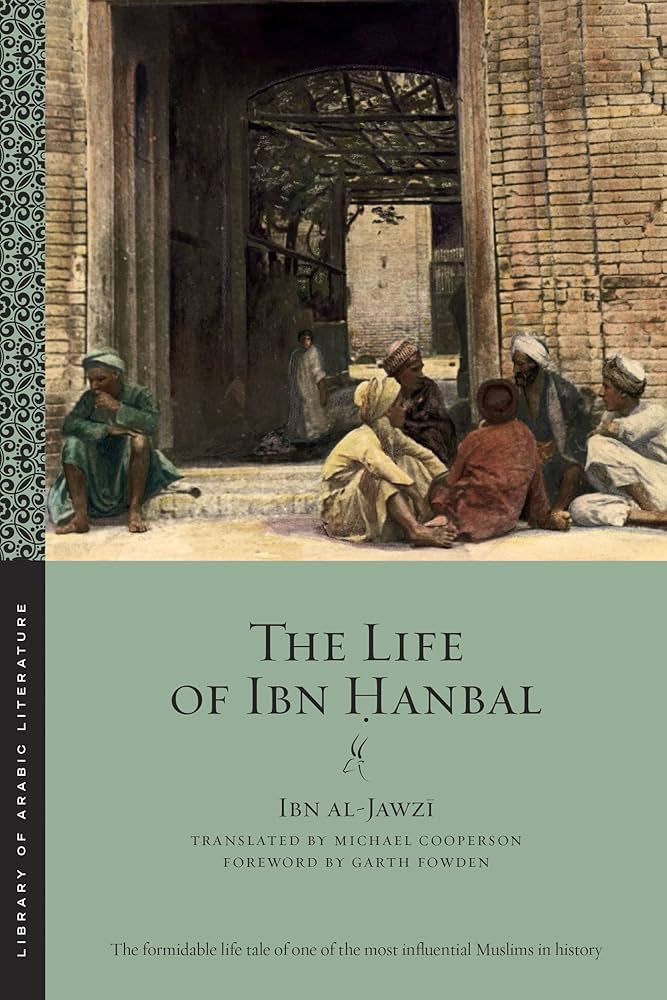
The Life of Ibn Hanbal by Ibn al-Jawzī
Reviewed by Abdul Hai
أُحِبُّ الصَّالِحِينَ وَلَسْتُ مِنْهُمْ
لَعَلِّي أَنْ أَنَالَ بِهِمْ شَفَاعَةً
وَأَكْرَهُ مَنْ تِجَارَتُهُ الْمَعَاصِي
وَلَوْ كُنَّا سَوَاءً فِي الْبِضَاعَةِ
“I love the righteous, though I am not one of them…
perhaps I may attain their intercession.
And I hate those whose trade is sin…
even if we were equal in merchandise”
-Abu Abdullah Muhammad bin Idris Al-Shafi’i
In modern times, it is often difficult to find the proper words to write about righteousness or truly righteous individuals, for genuine righteousness and upright personalities have become exceedingly rare. One’s vocabulary itself often feels limited, owing to the scarcity with which such virtues are encountered, spoken of, or witnessed in practice. Yet, from time to time, a rare opportunity presents itself to reflect upon and write about such noble qualities and distinguished personalities. I, with all the sincerity I can muster, consider this to be one such occasion, and I praise Allah (the Most High) for it.
Often honoured with the title “al-Ṣiddīq al-Thānī” (the Second Siddīq, the first being Abū Bakr), Imaam Abū ʿAbd Allāh Aḥmad ibn Muḥammad ibn Ḥanbal ibn Hilāl ibn Asad al-Shaybānī is regarded as one of the most renowned scholars in Islamic history. He is distinguished not only for his vast scholarship in ḥadīth and jurisprudence but also for his steadfastness during the Miḥnah (the Inquisition), a heterodoxy-theological trial concerning the so-called createdness of the Qur’an.
Born in Baghdad in 164 AH and passing away in 241 AH, the life of Ibn Ḥanbal was marked by numerous trials and tribulations, many of which have been extensively documented by the eminent Baghdadi scholar and preacher, Abū al-Faraj Jamāl al-Dīn ʿAbd al-Raḥmān ibn al-Jawzī (d. 597 AH), in his celebrated work Manāqib al-Imām Aḥmad ibn Ḥanbal. An abridged English translation of this work has been produced by Dr. Michael Cooperson under the title The Life and Work of Ibn Hanbal; it is this translation that is under review.
Were the permissibility of the phrase فِدَاكَ أَبِي وَأُمِّي يَا أَبَا عَبْدِ اللهِ (may my father and mother be your ransom, O Abū ʿAbd Allāh”) for the deceased not a matter of scholarly dispute, I would proudly utter it for Imām Aḥmad. For indeed, as Imām Ibn al-Jawzī’s account makes abundantly clear, his life and legacy are truly deserving of such profound admiration and affection.
As the founder of the fourth Sunni legal school, Imām Aḥmad’s life has become a central subject of study, and the English translation of this work serves as a useful introduction, being based on a classical biography written by a major pre-modern scholar. Ibn al-Jawzī presents the life and struggles of this remarkable Imām with great reverence and details. The work consists of roughly one hundred chapters of varying length, in which Ibn al-Jawzī predominantly employs the tradition-based (akhbārī) narrative style characteristic of his period.
Across these chapters, Ibn al-Jawzī covers nearly every aspect of Imām Aḥmad’s life, from his birth and childhood to his teachers, his methods of learning, and his intellectual formation. The work also records the praise he received from his teachers, his journeys in pursuit of knowledge, as well as those who studied under him. In addition, it highlights his devotion to the Qur’an and to the study of ḥadīth, alongside discussions of his spiritual outlook and practice. It further records his engagement with poetry, alongside the more intimate texture of his life: his household and its furnishings, his clothing, his children, his wife, and the women of his household. The narrative also addresses his imprisonment, and distinguishes between those he esteemed and those he regarded with disapproval.
Perhaps what brought Imām Aḥmad to the forefront of Islamic intellectual history was the Inquisition (al-Miḥna). This was the doctrinal controversy surrounding the claim that the Qur’an is created rather than being the uncreated speech of Allah, a position promoted by the Muʿtazilite theological school under the leadership of Abū ʿAbd Allāh Aḥmad ibn Abī Duʿād al-Iyādī (d. 240 AH/854 CE), a prominent official and staunch opponent of Imām Aḥmad.
It is in this section of the work that Ibn al-Jawzī most clearly illustrates the stature and significance of Imām Aḥmad. He records the beginnings of the Inquisition (al-Miḥna) and presents, in considerable detail, Imām Aḥmad’s position and his responses to those who advanced the doctrine that the Qur’an is a created entity.
The narrative includes the extensive debates between Imām Aḥmad and Ibn Abī Duʿād, as well as others, conducted while he was held under restraint and, as described in the sources, shackled during his confinement in Baghdad. It also recounts the exchanges between Imām Aḥmad and the caliph al-Muʿtaṣim, who repeatedly addressed him, saying:
“Aḥmad, I wish for you what I would wish for my own son Hārūn (al-Wāthiq). So tell me: what do you say concerning the Qur’an?”
To which Imām Aḥmad is reported to have replied:
“Give me something from the Book of Allah or from the Sunnah of the Messenger.”
What distinguished Imām Aḥmad was his clear and unwavering conviction that the Qur’an is the uncreated speech of Allah. This clarity and firmness rendered him, in the eyes of the people, a figure worthy of emulation and admiration, and he became a symbol of steadfast resistance in upholding what he believed to be the truth. As a result, people gathered around him and took inspiration from his stance, with some advising him to remain steadfast upon the truth for the sake of Allah.
Al-Anbarī, better known by the kunya Abū Jaʿfar, is reported to have visited Imām Aḥmad and said:
“Listen today, you have people ready to follow your example. If you say the Qur’an is created, many will say the same. If you stand firm, many will stand with you. And consider this: even if the caliph does not kill you, you will die regardless. So fear Allah, and do not give in.”
The Inquisition continued throughout the reign of al-Muʿtaṣim and his son al-Wāthiq. It was during the rule of al-Muʿtaṣim’s other son, al-Mutawakkil (Jaʿfar), that Imām Aḥmad ultimately gained favour, was released from imprisonment, and the Inquisition was brought to an end. Following his release, Imām Aḥmad returned to his scholarly life, although he is reported to have reduced his teaching and transmission of ḥadīth thereafter. He passed away on a Friday in Rabīʿ al-Awwal in the year 241 AH, bringing to a close a life defined by scholarship, devotion, and steadfast commitment to Allah and His Messenger (peace and blessings be upon him).
One reads biography for one of two reasons: entertainment, or instruction. The reading of the life and work of Imām Aḥmad ibn Ḥanbal undoubtedly belongs to the latter category. Yet this raises an important question: how does one derive lessons from his life and apply them to the contemporary world, particularly within the context of the modern Muslim world and its many complexities?
The responsibility for deriving such lessons and understanding the realities that continue to afflict the Muslim world primarily lies with أَهْلُ الحِلِّ وَالعَقْدِ ( “the people of authority and binding decision”). Traditionally, this term refers to those vested with the authority to deliberate and make binding decisions on behalf of the Muslim community. The scholarly class of Muslims in the West, however, largely stands outside this category in any meaningful institutional sense, even where some claim the mantle.
It seems that much of the contemporary scholarly class in the West draws lessons from the early Muslims including Imām Aḥmad primarily through the lens of spirituality, personal rectification, and inner purification, while often neglecting the dimension of struggle, resistance, and principled confrontation with political authority that equally defined the lives of these figures. Imām Aḥmad’s firmness in the face of state coercion during the Miḥna was not merely a matter of personal piety, but a public and intellectual defence of truth against institutional pressure.
This aspect of his struggle appears, at times, to be sidelined in modern religious discourse. One finds scholars speaking at length on spirituality, self-reformation, historical curiosities, and questions of social belonging, while remaining conspicuously silent on the crises facing the Muslim world today: crises of war, occupation, oppression, and mass suffering. Such silences raise serious questions about scholarly priorities, and ultimately about credibility.
What seems to emerge in certain strands of contemporary neo-traditionalism is a conception of religion that functions primarily as a comfort zone: opening the heart to spirituality, but often neglecting the harsh political and social realities in which Muslims live and die. Yet the life of Imām Aḥmad demonstrates that there is a time and place for both inward spiritual cultivation and outward steadfastness upon truth. A religious discourse confined to comfort, detached from the lived struggles of ordinary Muslims, risks becoming disconnected from both reality and relevance.
Dr. Michael Cooperson’s translation of The Life and Work of Ibn Hanbal is a much-needed contribution to the English-language world, for this, Dr. Cooperson deserves both appreciation and high regard, for he has made accessible to a wider audience an important work of Islamic intellectual and spiritual history. This volume is not merely a valuable resource for the scholarly class or for students of the Islamic sciences; rather, it is a work that should be read by the wider Muslim community. The struggle of Imām Aḥmad is not one frozen in history, confined to a particular time and place. Rather, it is a struggle whose themes remain deeply relevant to the lived realities of Muslims across the world. In particular, within the political and social climate of the Western world, the life of Imām Aḥmad continues to serve as a source of inspiration: a model of steadfastness upon one’s religion and worldview, while navigating the complexities and pressures of contemporary society. His life demonstrates what it means to remain firm upon truth and principle: firm even, and especially, when the cost is real.