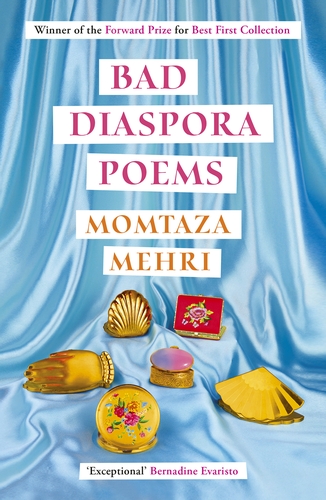
Bad Diaspora Poems Momtaza Mehri
Reviewed by Abdul Hai
World history is a history of colonisation and displacement. All empires are guilty of this. However, there is something particularly unique and disturbing about Western colonisation, especially that of the British Empire, which scarred human history so deeply that its echoes remain within our collective consciousness. The West did not colonise the ‘others’ solely for wealth; rather, within the colonial imagination, the ‘others’ were often not regarded as fully human. As Rudyard Kipling puts it in his poem The White Man’s Burden, they were regarded as “half-devil and half-child”.
Although the vocabulary of colonisation may have changed, the structure of such ideas has surely remained. However, there is now one significant difference: the colonial diaspora has begun to voice its side of the story in the language and vocabulary of its former colonisers. One such powerful voice is that of Momtaza Mehri, a young British-Somali poet who, in her collection Bad Diaspora Poems, published by Jonathan Cape, presents a powerful, intellectual and highly sophisticated voice. Mehri’s collection is about diaspora, belonging and migration, as well as the very complicated relationship between the colonised and the coloniser; between home and displacement; and between the expectations of being a member of the West and the pursuit of justice as the child of immigrants and refugees, particularly through the experience of the Somali diaspora. It also explores colonial history, identity, memory and the struggle to find a place amongst, and within, the societies of former colonisers.
The very title of the book, Bad Diaspora Poems, is provocative. Mehri is asking a question: what does a ‘good’ diaspora poem have to be? Diaspora poetry is often written from a single angle, presenting simple ideas such as immigrants leaving their countries, suffering or struggling. Mehri, however, shows that the story is not that simple but rather very complex and deep, containing many different kinds of emotions, experiences and identities. She shows that diaspora is not simply about displacement; it also involves humour, love, history, belonging, happiness and anger. The collection creates an atmosphere of sophistication that moves beyond that of a typical poetry collection. It moves between borders, languages, cultures, religions, histories, socio-economic realities and political spheres. It is this shifting that brings out the very uniqueness of the collection.
Mehri does not give the reader the usual story of what happened and what history says happened; rather, she creates an image in the mind of the reader, which then allows the reader to almost feel and see the event in their mind. It is this complexity of arrangement and fragmentation within her collection that can be said to be its mastery. With this complexity and fragmentation, she adds another, perhaps universal, tool to her poems: humour, irony, anger, playfulness through intellectualism, grief and, in some cases, violence. Take, for example, her poem entitled Wink Wink:
“cascade of iced tea / & sugared straws // then a line / break // hot spray of bullets & / reverb”
In verses such as these, Mehri creates a very effective shift from domestic pleasure and enjoyment to the almost violent brutality of gunfire. This works particularly well in a poem that seeks to show two contradictory emotions, as noted by Nenadović (2026): “Often, contradictory emotions are experienced simultaneously and for the same reason” (p. 88).
Mehri’s ability to shift between two contradictory emotions is not merely a poetic skill but rather a reflection of the reality of the struggle experienced by the children of the diaspora. It is these two states of mind the state of belonging and that of not belonging that allow a uniqueness of language and pattern to emerge. The collection, in many ways, gives a window into the mindset not only of the children of the diaspora but also into their internal restlessness. Mehri’s use of all available literary tools, such as prose and lyric, as well as her use of digital tools such as WhatsApp and text messages, demonstrates a very contemporary appeal. Using contemporary tools allows the collection potentially to reach audiences beyond literary circles (Sacks, 2021), and this is particularly relevant, as the children of the diaspora have, in some ways, lost their heritage and culture. Mehri, by using the language and tools that young people understand, seeks to reconnect them with history, culture and heritage, using language that can be understood.
What most frightens the colonisers is the idea that the colonised should learn and become politically active and aware, and this is exactly what Mehri has become. She is as political as one can get through her collection. She shows a deep understanding and sophistication in narrating history in the form of poetry. She demonstrates an understanding of historical events and how those historical events shape our world today. This is vital because it shows and indicates to the contemporary colonial mindset that it will no longer be able to narrate the story of formerly colonised people without challenge. Take, for example, the poem Rimbaud in Harar, where Mehri reclaims the narrative. In her verse:
“settlers drink from reservoirs of good will
spit forth their catalogued observations”
In this poem, Mehri challenges the way the coloniser looks at the people they have colonised. The phrase “settlers drink from reservoirs of goodwill / spit forth their catalogued observations” shows that the settlers takes places from local people and describe those places from their own worldview. The word ‘spit’ is particularly significant because it conveys disrespect and harm towards local people. Mehri then skilfully turns Arthur Rimbaud’s (1854–1891) view of Harar, (the old walled city in eastern Ethiopia,) and reverses it. Now, it is the settler who is being watched and judged. Mehri does not allow the coloniser to remain the observer; rather, she shows how the settlers are now being watched and judged, therefore taking control of the narrative. In the poem, Harar is given a human voice and becomes the judge. This approach is the beginning of correcting the narrative of the Somali and other diasporas. There is no doubt that Mehri is a young, outstanding and visionary poet, and her collection not only demonstrates this but also presents a very confident and independent voice one that is willing to challenge history, dominant narratives and, most importantly, those colonial mindsets from which she demands that her belonging and heritage be acknowledged and respected. Keeping this in mind, her collection must be read, studied and, most importantly, belong in every Muslim house.
Poetry is subjective in principle, so, in some ways, there is no such thing as good or bad poetry. In my personal view, however, ‘bad’ poetry is poetry that is unclear, complicated and difficult to understand, whereas good poetry is poetry that is clear, straightforward and communicates its message directly. With this in mind, I found Mehri’s poems to be somewhat different and difficult fully to appreciate, as they require some background historical and cultural understanding. It is here that Mehri shows her weakness. She fails to bring historical events to a level of language that is accessible to all, and because of this, her poetry may be limited to a circle of historians, literary critics and advanced readers. It is vital that the children of the diaspora, especially Muslims, remember their history, their narrative and their sense of belonging. However, an overemphasis on displacement and the past may, in some ways, work against the diaspora cause. If such narratives are overemphasised, the diaspora may never be able fully to call the land in which they now live their home. The Muslim diaspora is not going anywhere. Although, in principle, I agree with the idea of hijrah, the reality is that many Muslim lands are in a far worse condition, and hijrah would not necessarily be wise. We are here, we are staying, and this land belongs to us as much as it belongs to others.
Allah (may He be exalted) says:
إِنَّ ٱلْأَرْضَ لِلَّهِ يُورِثُهَا مَن يَشَآءُ مِنْ عِبَادِهِۦ وَٱلْعَـٰقِبَةُ لِلْمُتَّقِينَ
“Indeed, the earth belongs to Allah alone. He grants it to whoever He chooses of His servants. The ultimate outcome belongs only to the righteous.” (Qur’an 7:128)
There is, however, another way of understanding diaspora. The Muslim, in a way, is always in a state of diaspora, since our real home and final place is in the Hereafter. The Holy Prophet (may Allah’s peace and blessings be upon him) said:
” كُنْ فِي الدُّنْيَا كَأَنَّكَ غَرِيبٌ، أَوْ عَابِرُ سَبِيلٍ
Be in this world as though you were a stranger or a traveller.” (Sahih al-Bukhari)
We Muslims are therefore, in a spiritual sense, in a state of diaspora. Wherever we are, we remain part of a spiritually displaced community. What is required of us is to establish and follow our religion as much as we can while we are in this world. This requires us to study, learn and understand our Islamic traditions as they were understood by the early Muslims. Through this, we must build our understanding of belonging and reclaim our narrative not only from our former colonisers but also from those who claim to belong to our traditions yet show hatred towards what our tradition has to offer. It is in this sense that I believe the idea of diaspora can be understood beyond the physical experience of migration, displacement and belonging. Bad Diaspora Poems should not only be about migration, belonging and the relationship between home and displacement; rather, it should also include our displacement from the Hereafter to this world, the migration from the land of eternal happiness to the pain of this world, and the experience of spiritual displacement. Mehri examines what it means to be displaced from one home, but from an Islamic perspective, the human being is also spiritually displaced from the ultimate home, the Hereafter, and temporarily situated in this world. In this sense, diaspora is not only a geographical or cultural condition but also a spiritual reality.
References
Lewis, J. (2021). Women of the Somali diaspora: Refugees, resilience and rebuilding after conflict. Oxford University Press. https://doi.org/10.1093/oso/9780197619421.001.0001.
Mehri, M. (2023). Bad diaspora poems. Jonathan Cape.
Nenadović, A. (2026). The uneasy delight of diaspora: Momtaza Mehri’s Bad diaspora poems. Forum for Modern Language Studies, 62(1), 83–101. https://doi.org/10.1093/fmls/cqag003.
Sacks, S. (2021). Networked poetics: WhatsApp poetry groups and Malawian aesthetic networks. In L. Makalela & G. White (Eds.), Rethinking language use in digital Africa: Technology and communication in Sub-Saharan Africa (pp. 137–154). Multilingual Matters. https://doi.org/10.21832/9781800412316-009.