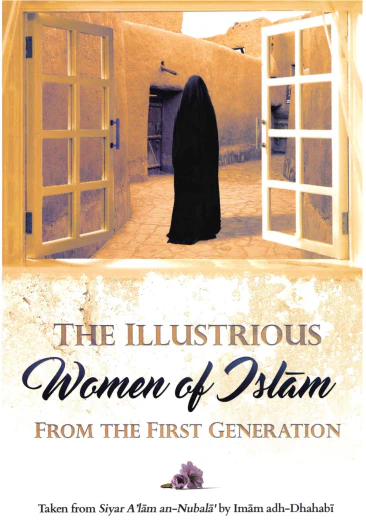
The illustrious women from the first generation by Imam adh-Dhahabi and Ibn Hajar al Asqalani
Reviewed by Muminah Khan
Within contemporary discourse particularly across social media, Western news outlets, propagandistic sources, and far-right political rhetoric several narratives are propagated to incite fear and hostility towards Islam. One of the most persistent is the assertion that Muslim women are inherently oppressed, devoid of autonomy, and condemned to passive, meaningless lives, and that such conditions have defined their existence since the inception of Islam. The Illustrious Women from the First Generation by Al-Dhahabi and Ibn Asqalani fundamentally challenges this narrative through a compilation of biographical accounts of early Muslim women, grounded in hadith literature and the Holy Qur’an.
Al-Dhahabi’s contribution to the text lies in his utilisation of hadith, carefully distinguishing between authentic and weak reports in order to present the lives of the Prophet Muhammad’s (peace be upon him) earliest female companions. This methodological rigour underscores the credibility of these accounts, as the verification of transmission chains (isnad) constitutes a cornerstone of historical reliability within the Islamic tradition. The work encompasses narratives of his wives, nursing mothers, daughters, granddaughters, paternal aunts, paternal cousins, nursing sisters, and women among the Muhajirun—many of whom have been largely overlooked and are seldom referenced in contemporary discourse.
Engaging with these biographies is both moving and thought-provoking. On the one hand, the reader is inspired by the intellectual strength, resilience, and courage of these women; on the other, there is a sense of sorrow upon recognising how little attention they receive within the Muslim ummah. In many Muslim communities, familiarity with prominent female figures from Islamic history remains limited, with only a few names widely recognised. By contrast, there is often far greater awareness of contemporary singers and celebrities. This disparity prompts an important question: who, in reality, are we choosing as our role models?
These women were far from passive. They played a formative role in shaping the early Muslim community in numerous waysthrough the propagation of Islam, the transmission of knowledge, and the demonstration of courage and intellectual capacity. Figures such as Khadijah bint Khuwaylid (RA), whose emotional support for the Prophet was indispensable; Nusaybah bint Kaʿb (RA), who took up a shield and sword to defend the Prophet (peace be upon him) when others retreated from the battlefield; and Aisha bint Abu Bakr (RA), who was widely recognised for her intellectual authority and extensive contributions to hadith transmission, exemplify the diverse roles undertaken by women in early Islamic society. The text provides countless further examples of women contributing to both religion and society in a variety of significant ways.
A particularly notable aspect of the book is its portrayal not only of these women’s devotion to Allah, but also of their humanity. They were not merely pious figures, but individuals of intellect, wit, and emotional depth who helped shape the world in meaningful ways. The book challenges the Western tendency to depict Muslim women as oppressed and lacking agency or fulfilment simply because they choose to observe modest dress. Al-Dhahabi demonstrates, through carefully selected hadiths, that these women led lives that were intellectually vibrant, socially engaged, and deeply purposeful. The narratives capture a full spectrum of human emotion they laughed, and experienced anger, frustration, happiness, and jealousy rendering them relatable even to contemporary readers. There are numerous instances in the lives of these remarkable women which illustrate that even the most exemplary individuals were not exempt from the complexities of human nature. By foregrounding both their achievements and their humanity, the text offers a nuanced and compelling representation of early Muslim women.
The structure of the book further enhances its readability and contributes to an engaging reading experience. It is divided into two distinct sections: the first, authored by Imam Al-Dhahabi, presents detailed biographical accounts, while the second, compiled by Ibn Asqalani, adopts an encyclopaedic format. This organisation enables readers to access information with relative ease and efficiency. The dual structure is both distinctive and particularly valuable within the context of Islamic scholarship, where knowledge is traditionally preserved through chains of narration and often dispersed across numerous primary historical sources. The consolidation of such material into a single volume therefore represents a practical and significant scholarly contribution. Furthermore, while many Islamic texts may present linguistic and conceptual challenges for the lay reader, the accessibility of this work is enhanced by its clear and straightforward English translation, supplemented by footnotes and translator’s annotations that provide additional context and aid comprehension.
The portrayal of humanity constitutes one of the book’s greatest strengths. It presents these women as role models, yet not as distant or unrelatable figures. Their struggles, emotions, and achievements render them vivid and authentic, allowing their stories to continue resonating with Muslim women today. The text offers a source of inspiration grounded in the teachings of Allah and His Messenger, reminding women that they need not conform to Western narratives or appeal to Western standards in order to lead fulfilling and meaningful lives. The Illustrious Women from the First Generation challenges the misrepresentation of Muslim women, demonstrating that their lives were and continue to be powerful exemplars of agency, humanity, and inspiration.