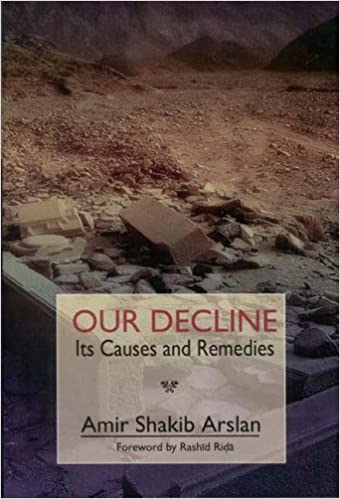
Our decline its causes and remedies
Reviewed by Abdul Hai
Amir Shakib Arslan (1869–1946) appeared in a cloudy chapter of Islamic history. To many, it was the last chapter of a religion, a civilisation and, most importantly, an empire, namely the Ottoman Empire. However, Arslan represented a different view. He was a natural-born politician, writer, poet, historian and known as Amir al-Bayān (“Prince of Eloquence”). As a pan-Islamist and supporter of the Ottoman Empire, he viewed the world through Islamic values and, notably, was one of the most vocal voices of the anti-colonialist movement. He was born into a Druze family, but his commitment to Druze beliefs was shortened due to the influence of Jamal Uddin Al-Afghani (1838–1897) and Muhammad Abdu (1849–1905) and, in particular, his later relationship with the leader of the Egyptian movement, Rashid Rida (1865–1935). Due to the aforementioned influences and his keen interest in understanding the true Islamic teachings, he openly viewed Islam through the Qur’an and the Sunnah. Arslan shared the same da‘wah as Rida, which was to establish Islam through the Qur’an and Hadith, which contained some elements of anti-taqlid and opposition to the legal schools, as well as a distinct element of pro-modernism.
OUR DECLINE: Its Causes and Remedies is a reply to a letter by Muhammad Bistooni Umran, a student and admirer of Shaykh Rashid Rida and the Al-Manar movement. The letter was addressed to Shaykh Rida with two main questions, namely: 1. What are the causes that led to the weakness and decline of the Muslims, in both religious and worldly affairs? 2. What are the reasons and causes for the progress of the Europeans, Americans and Japanese? Even though Umran had addressed the letter to Rida, he requested that those two questions be answered by Arslan. Umran wanted to appreciate Arslan’s progressive yet traditional experience and, thus, Arslan became the target of his questions. The book is divided into seven chapters, elaborating on Umran’s two questions, with some concluding discussions. In chapter one, Arslan begins to identify and highlight the causes of the advancement of the early Muslims. His thesis in this chapter can be narrowed down to two main points.
The first point is that the early Muslims viewed the world through Islamic teachings and values. The Qur’an and the Prophetic traditions were the only legislative body. The religious doctrine was not only operative in the religious environment and personal space but also permeated the public domain and controlled the very fabric of the socio-economic sphere, thus winning Allah’s support in both religious and worldly affairs.
The second point is that the early Muslims understood Islam to be both a theological and legal framework for Muslim life and that Islam is a religion that demands action from its followers, as noted by Arslan (2004, pp. 6): “How can you expect that God will help a nation that shuns the field of action(s)?” It is the combination of those primary principles, Arslan notes, that enabled the early Muslims to be successful. Contemporary Muslims have divorced themselves from these principles, which have resulted in their deterioration.
Chapters two and three are probably the most important and provide direct answers to Umran’s questions. Chapter two begins with a comparison between modern Muslims and Europeans. Arslan asks, rhetorically, what the Muslim nations have sacrificed for their religion, whilst Europeans spent trillions of pounds and countless lives to defend their Christendom and their way of life. This chapter creates a very powerful image of Muslims, for whom religion is said to be seen merely as lip service and a cultural heritage. Muslims desire victory, Arslan notes, through the mere virtue of being Muslim, with no zeal. Arslan also makes a comparison between factual figures concerning Western ideologies and Islam in relation to wars and advancement. He states that unless Muslims take a more proactive role in aiding their religion, help from Allah will never sail to their shore. Allah says, “If ye will aid (the cause of) Allah, He will aid you and plant your feet firmly.” Arslan assures the Muslims that wealth is at their disposal. Muslims are not poor but brain-dead.
A comparison is also made between the existence of brotherhood among Europeans and that among Muslims. Muslims harvest the very seed of disunity unless, the chapter goes on to say, Muslims become one body, as mentioned in the Qur’an and Hadith. Muslims will never raise their heads again, and Europeans will be their unquestionable masters.
Chapter three highlights the extent to which Muslims have forgotten and betrayed their religion. The main treason against the Muslims was committed by their fellow brethren, especially the so-called religious and political leaders. Riff Muslims, for example, became victims of such treason. Several religious and political leaders, Arslan notes, “aspired to alliance with the French and the Spaniards, carrying favour with them and hankering after honours and titles from them…” The chapter then narrates a list of treasons by different Muslim groups against their fellow brethren. This chapter rages with anger about religious and political leaders such as Maqree, the Minister of Morocco, and Baghdadi, the Pasha of Fez and also Grand Mufti of Fez. All these men played a vital role in destroying Islam and its principles. It was Maqree who supported the Moroccan Catholic journal in publishing an anti-Islamic narrative of events. The chapter recollects events and narratives that contributed to the downfall of the Muslims, such as ignorance and cowardice. Arslan ends the chapter with a description of two extremes that contributed to the decline of the Muslims, namely the extreme conservatives and the fanatic modernists. The chapter is filled with quotations from the Qur’an and the Sunnah, which Arslan uses in support of his argument concerning decline.
Chapter four discusses in detail the question of national identity. All nations, groups and tribes are engaged in defending their national identity, and Europeans are not an exception. The chapter is an open field of examples, most of them being from Europe, such as the struggle of the Irish against the English and the daily fight of the ‘Britons of France’ to remain British. He mentions Switzerland, Germany and Russia, all fighting and struggling against forces to remain and uphold their social, cultural and moral values. Those national folktales become a source of inspiration, unity and strength and, most importantly, a source of reference. However, the chapter ends with the difficult question of Muslims being confused about their identity. Although Muslims are to be a nation of divine identity (i.e. Islam), contemporary history has proven that Muslims “who do not seem to understand their values…” view the Qur’an, Sunnah, religious traditions and civilisation, culture and Arabic language as sources of backwardness. The chapter ends with a discussion of the dangers that secularism and other ideologies have upon the Muslim mind.
Secularist philosophy has surely contributed towards the downfall of the Muslim Ummah. However, there is another philosophy which, according to Arslan, should also be held responsible for the Ummah’s downfall, as this philosophy of ultra-conservatism in Islam is the theme of the fifth chapter. Arslan discusses, with examples, how the ultra-conservative approach to Islam had created a non-progressive movement and closed the door to all sciences. Islam had divorced all its relations with this world, and the Hereafter becomes the only source of life for these ultra-conservative Muslims. Arslan notes that Islam is a realistic religion in which the world (dunya) has its role, which is supported by a number of scriptural texts. The Qur’an is full of verses in which men are required to commit to actions that will benefit them in this world and the next; the Qur’an is primarily anti-idleness. Arslan quotes over 26 verses to support his claim. Allah has given us the intelligence to be creative and to benefit the Ummah with it. Our intelligence has a role and function, and it should not be cut off or abandoned. The ultra-conservative approach to Islam becomes a source and tool for the enemies of Islam. As Arslan notes, the enemies were able to cogently argue the case that Islam was a religion that was primarily against development and civilisation, an idea which is refuted by the Qur’anic elan and historical reality.
The greatness of Islamic civilisation is questioned by the West and its followers in the Muslim world. Chapter six is a window into the falsehood of such a claim. Arslan, in this chapter, highlights that Islamic civilisation enjoyed its fruits [successes] as long as the social and private laws of Islam were upheld. Therefore, Islam cannot be blamed for the Muslim downfall; he notes, “the backwardness of Muslims in modern time is not due to their religion, but to their ignorance of the teaching of their religion and neglect of its principle…” This chapter provides a response to those who are critical of Islamic civilisation. Here, Arslan brings Islamic civilisation to life, arguing for its contributions in all areas of science and development. He argues that fair-minded Western leaders and thinkers such as Napoleon have accepted this narrative. The chapter goes on to contrast Islam’s contribution to development and civilisation with that of Christianity. According to Arslan, the former was productive while the latter was destructive. The chapter ends by highlighting the fact that the Qur’an has enjoined upon Muslims the acquisition of knowledge of both this world and the Hereafter. If the Muslim nations ought to show determination like other nations, then achieving power and glory will not be impossible.
Chapter seven moves on to the issue of Islam and nationalism. The fashion among Arslan’s contemporaries was for the Arab people to identify themselves with the blueprint of nationalist values, while religious values were side-lined or neglected. According to this perspective, nationalism was the way forward, as faithfulness to religious values kept society backward. Arslan attempts to challenge this understanding. He highlights that religion must play a role in our development and our unification as an Ummah. The Islamic principles, which are based on the teachings of the Qur’an and Sunnah, must be adhered to; if these two core principles are removed from the socio-economic life of a Muslim, then atheism will creep in. A useful part of this chapter points out that although Europeans like to think that they have developed in a way separate from their religious dogma, this is historically false, as almost all of their centres of learning have a religious background.
The present-day Muslims have lost all confidence in themselves and their faith, the chapter notes, and they have lost the battle before it had started. The chapter gives a number of examples, such as the fact that Muslims have no desire for independent thought, and they have become the blueprint of Western theory and Western ideology. The chapter provides many examples to show how the Ummah has lost all hope of ambition and development; he mentions, as an example, the famous railway project commissioned by Sultan Abdul Hamid II to connect Sham to Hijaz. To promote this project, Arslan wrote a poem, and the response was that “most of those westernised Muslims launched sharp attacks against me; it is as if I have committed an act of apostasy by supporting [this] project”. Another example is the establishment of the Bank of Egypt. The chapter intends only to highlight the chaos and confusion the Muslim nations were experiencing due to accepting the Western narrative of belonging, and thus nationalism became the religion to be followed. The chapter ends with the mention of a certain Muhammad Talaat Basha who “…understood that nothing is beyond the capacity of Muslims…”, thus giving hope to the dying nations.
The book concludes by mentioning that the greatest principle which will bring about change in the Muslim world is sacrifice. Until Muslims learn to sacrifice, they will never succeed in this world or the Hereafter. Imitating Western nations will only enslave the Muslims. No nation has ever succeeded without sacrifice. Muslims must take their inspiration from the Qur’an and Sunnah, which are the source of all success. Our decline and downfall are due to our neglect of religious values. The author ends his book by mentioning the saying of Allah: “and those who strive in Our cause, we will certainly guide them to our paths: for verily Allah is with those who do right” (al-Ankabut 28:69).