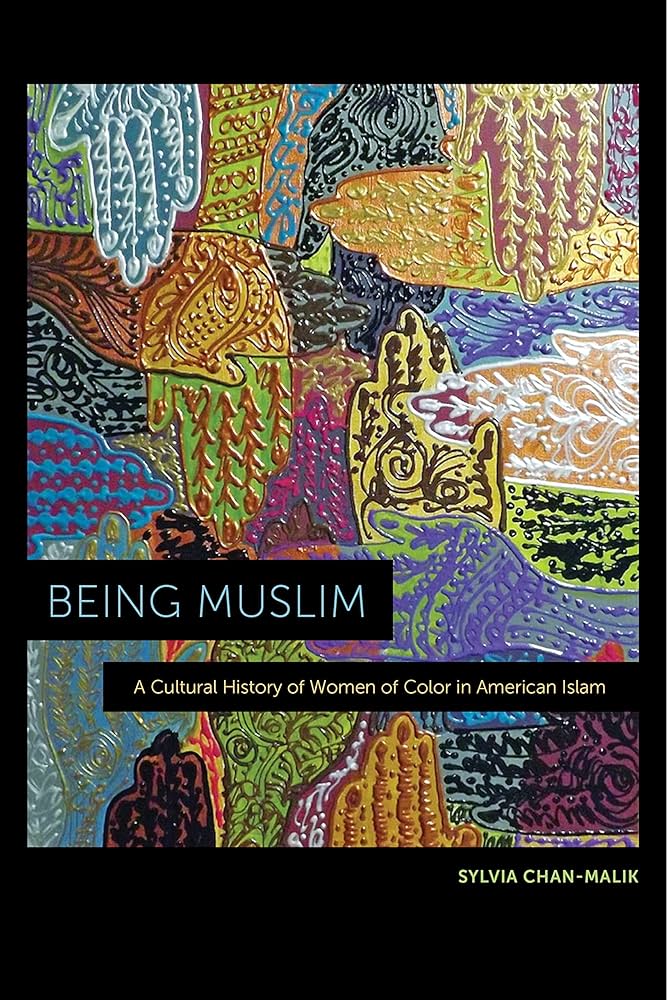
Being Muslim: A Cultural History of Women of Color in American Islam by Sylvia Chan Malik
Reviewed By
Abdul Basith Basheer
The story of Muslims in the United States is one that spans multiple centuries and involves a diverse group of people, from enslaved populations to immigrant communities and more. Because of the 9/11 attacks and continued political intervention in the Middle East, Islam and its vibrant expression in America has been at the forefront of mass media, politics, and popular culture discourse. It is easy to make mention of prominent Muslims in America who have become relevant in the discussions around American society. From politicians to entertainers and athletes, Muslims in the United States are becoming more and more recognized, even considering growing xenophobia and racism directed towards practitioners of the faith. But what about the lives and experiences of the everyday Muslims in America; the individuals who are not famous but merely go about their lives, existing as both citizens of this country and remnants of a centuries-old faith-based tradition? What can we learn from their stories? And how do they contribute the tale that is the history of Islam in this country?
Professor Sylvia Chan-Malik’s work, Being Muslim: A Cultural History of Women of Color in American Islam, attempts to add to this story of Muslims living in the United States. What experiences did women of color, specifically Black women, have that contribute to their own understanding of their religion, but also their lives as women in American society? Stories can be transformative, and as such, the stories Chan-Malik includes in this book say much about the perseverance, dedication, and activist spirit these women exuded. Her focus is the experiences of African American women who practiced Islam and developed a unique relationship with the religion and their society at large. Some expressed their Muslim identity through activist efforts during the civil rights movement. Others combined their religious expression with aspects of their professional and personal lives. In short, this book is a history of Islam in America, but more specifically the ways women imagined themselves in that religious space.
We learn about Muslim women of color from vivid biographical stories. Betty Shabazz was the wife of prominent Nation of Islam preacher Malcolm X and one important figure highlighted in Chan-Malik’s book. The Nation of Islam was a black nationalist group that arose in the early 20th century in urban spaces in the United and grew as the civil rights movement of the 1960s raged on. Led by charismatic speakers like Elijah Muhammad and Malcolm X, the group appealed to African Americans who sought to change their racial standing in American society. The teachings of the group were heavily influenced by Islamic thought and culture, but many have debated whether the group was indeed Muslim. Eventually, Malcolm X and his wife Betty distanced themselves from the NOI and its teachings, embracing a more orthodox form of Islam. After her husband’s assassination, Shabazz continued to dive further into her newfound faith, becoming a bastion for the “moral, ethical, and spiritual” life of Black Muslim women. Betty’s story is one of many that Chan-Malik tells in this work, seeking to the place the individual experiences of these women at the forefront of discussions on American Islam. Chan-Malik details how “Shabazz grounded her identity as a Muslim woman in her marriage and prioritized her role as wife in order to protect and fortify herself against, and deftly maneuver, the oftentimes fraught and dangerous political conditions she confronted throughout her life.” Stories like Shabazz’s add to the narrative of Muslim women of color in 20th century America and their burgeoning and expanding perceptions of themselves and their faith.
Another individual discussed extensively in Chan-Malik’s work is Dakota Staton, who was a famous jazz singer who attained fame in the late 1950s and 1960s. Life as a notable public figure seemed to be just the tip of the iceberg for Staton, who would marry jazz trumpeter Talib Dawud, a member of the Ahmadi Muslim community in America. Her conversion to Islam would shine a light upon the Muslim American community, and spark discourse on the place of women in society. Staton’s famous interview in Jet magazine in 1962 was the first in which she presented herself publicly as Muslim. The piece “by Larry Still focused not on her musical career or vocal style but on her religious beliefs and practices, as well as her marriage…” Chan-Malik’s telling of Staton’s story is fascinating in that it involves a prominent popular culture figure whose Muslim identity was independent of groups like the Nation of Islam or similar. Furthermore, Staton’s life as a Black Muslim woman living as a performer is one that is interesting from a cultural standpoint. “A performer since her youth, Staton had grown up on stage, and as her remarks in the Jet feature indicated, she had come to realize there was little safety or security for a Black woman oftentimes playing for white audiences…” Both Shabazz and Staton help Chan-Malik drive the point home that Muslim women of color in 20th century America were diverse in their experiences and relationships with Islam and American society.
In the conclusion of Being Muslim, Chan-Malik details her personal connection to the subject matter of the books. Living as Muslim woman of color, as well as a convert to the faith, provides her with a common shared experience of the individuals in her book. This commonality and personal connection comes to light in Chan-Malik’s writing. In an age where it is difficult to attain a level of neutrality and sustain it, she does not shy away from her own voice and experiences. Rather, it is the very fact that she is also a Muslim woman of color that strengthens her work and grounds it in individual experience. When an author displays a fervent passion for the subject matter, it is easy to note while reading. Those who read Chan-Malik’s book will develop a genuine interest in the lives and experiences of these women, due to her masterful storytelling. The sign of an experienced narrator is the ability to introduce new characters in a way that makes them familiar and relatable to the listener, and Chan-Malik accomplishes that with Being Muslim. Reading about the experience of prominent Muslim women like Betty Shabazz and Dakota Stanton, or relatively unknown individuals like Dr. Laila Al-Maryati or Hazel Gomez, we get a sense of the impact these stories can have on anyone who interacts with them.
It is Chan-Malik’s unique ability to combine historical content with personal narration that makes this book an engaging read. For those with little knowledge of Muslim American history, she provides enough background information to bring you up to speed. Detailing the formations and histories of the Ahmadi Muslim Community in America, the Nation of Islam, the Iranian Women’s Revolution of 1979, and other important historical points of study, provides meaningful context to the stories that follow these portions of history at each chapters beginning. At the same, Chan-Malik does not let the historical context that serves as previews of more individualized stories get in the way of the meat of her book. By placing the beautifully narrated stories of these women at the crucial points of the work, she allows us the reader to develop a deeper connection with who these women were, are, and what they stand for. Chan-Malik forces us to understand histories of a religion, the United States as a cultural hub, and women as driving forces of society.
Stylistically, the book is not a burden to read. Often a book that aims to highlight some aspect of history can be oversaturated with glossy vocabulary that causes the reader to miss the point. Being Muslim presents itself in a way that provides adequate sophistication to the content of the book, while being consumable by anyone who is interested in culture or religious expression in the United States. At times, I found myself a bit impatient with the structure of some chapters. While wanting to get the individual stories from the get-go, it was occasionally a challenge to get through the expansive discussions on institutional, social, or political history. However, after going through a few readings of the book, it now makes sense why such contextual passages are included. Without them, the reader would be lost while reading about the experiences of these women Chan-Malik aims to highlight.
Overall, the book was an excellent read, both as a fan of history and someone interested in cultural expression. I would recommend the book to people interested in histories of the United States, and those seeking to understand different diasporic communities in America. With Islam maintain its place in the broader American discourse and consciousness, it would be useful to know about the history of Muslim communities in this country, as way to understand how the religion and its expression has changed. At the same time, I would recommend the book to anyone interested in learning more about the history of women of color in the United States, or generally women’s history at large.